
Klimabonus 2026, Electric Mobility · €500 · HEMS
Charging point: charge at home
Install a charging point for your electric or plug-in hybrid vehicle. Grant of 50% of the cost excl. VAT, up to €1,400 for an ISO 15118-20 charging point, and HEMS grant €500 (≥2 connected devices). Compare certified installers in Luxembourg.
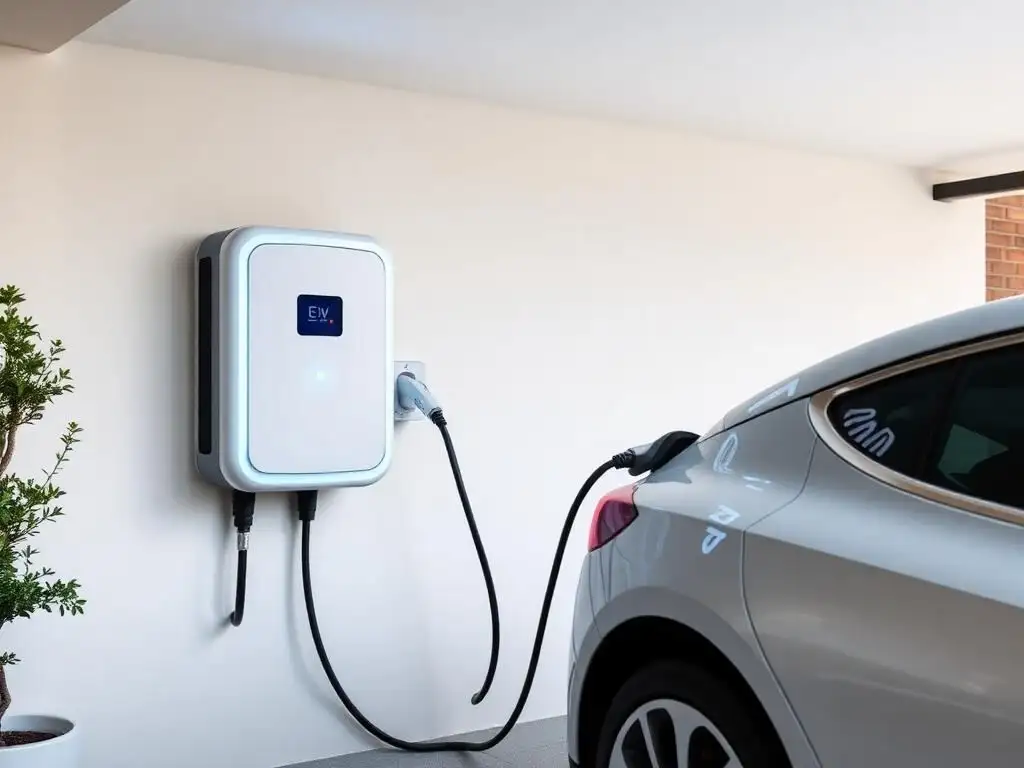
Up to €1,400 + €500 HEMS
Charging point: 50% of the cost excl. VAT, capped at €750 (standard), €1,200 (smart) or €1,400 (ISO 15118-20). €500 HEMS bonus granted when ≥2 devices are connected (charger, PV, battery, HP…).
100% free
A free service with no obligation for you
Certified installers
Network of verified professionals in Luxembourg
Get your estimate in 1 minute
🔒 No commitment · Reply within 24h
Charging point simulator
Estimate your charging point grants
Charging point grant cap
€1,400
Indicative amounts based on the official Klimabonus scale. Conditions on guichet.lu
Registered with the Chambre des Métiers
Our partner tradespeople hold a Luxembourg business licence and are registered with the Chamber of Skilled Trades.
100% Luxembourg-based
Vert.lu only works with companies established in the Grand Duchy — no forced cross-border sub-contracting.
Free and no commitment
You remain free to compare, negotiate or refuse any quote. No fee for homeowners.
Official information sources
- Ministry of Energy
- myenergy
- SuperDrecksKescht
- Enovos
How it works
- 1
Describe your project
Fill out our online form in just a few minutes. It's free and with no obligation.
- 2
Receive your quotes
Certified installers from your area will contact you with personalised offers, including your Klimabonus grants.
- 3
Compare and choose
Freely compare quotes, prices, and customer reviews to choose the professional that's right for you.
- 4
Installation and follow-up
Your installer takes care of everything: installation, connection, administrative procedures, and production monitoring.


Guide
EV charging points: preparing the installation properlyRead the full guide
Household socket or wallbox: a safety difference, not a comfort one
Charging an electric vehicle from a standard household socket puts the home's circuit under load for several hours close to its rated limit, which is not its original purpose and carries a risk of overheating on older installations or undersized wiring. A wallbox is designed specifically for this sustained use and includes its own protective devices.
A wallbox also communicates with the vehicle to adjust the charging current and cut power in case of a fault, which a simple socket cannot do. This design difference, more than charging speed, is what justifies a dedicated charging point once regular use is expected.
A dedicated protected circuit, and why load management avoids upgrading the connection
A charging point is connected to a dedicated circuit, protected by its own circuit breaker and, depending on the configuration, a residual current device suited to the DC fault current that an onboard vehicle charger can generate. This circuit must not be shared with other household loads.
The power available at the grid connection is contractually limited. A load management system automatically adjusts the power delivered to the charging point based on simultaneous household consumption, which often allows a charging point to be installed without applying for a higher connection capacity from the grid operator. This is worth checking with the installer before ordering equipment.
Single-phase or three-phase, cable choice and mounting location
A charging point can be supplied in single-phase or three-phase depending on the home's connection type and the desired charging power; three-phase allows higher power at equivalent current, but requires that the home's electrical installation support it. The installer determines the configuration suited to the existing distribution board.
The charging cable may be fixed to the unit or detachable depending on the model; a detachable cable reduces weather exposure and makes replacement easier. The mounting location must stay accessible from the parking space, protected from impact, and reachable with a cable length compatible with the vehicle.
Installation in a house versus a shared underground car park
In a single-family house, installation generally amounts to running a circuit from the distribution board to the parking space. In a co-owned building the situation differs: installing a charging point in a shared underground car park requires a decision by the general meeting of co-owners, individual metering so each user pays for their own consumption, and often a collective assessment of the infrastructure needed for several future charging points.
Planning this shared infrastructure ahead of time, even without immediately installing several points, avoids repeating structural work for every new request. A well-informed managing agent or co-owners' council typically commissions a technical study before putting the matter to a vote.
The grid operator, the authorised electrician and smart charging with solar power
The grid operator must be informed of the installation of a charging point, in particular to check the capacity of the existing connection; the installer usually handles this as part of the project. The installation itself must be carried out by an electrical company holding a business permit, because of the specific protective devices required.
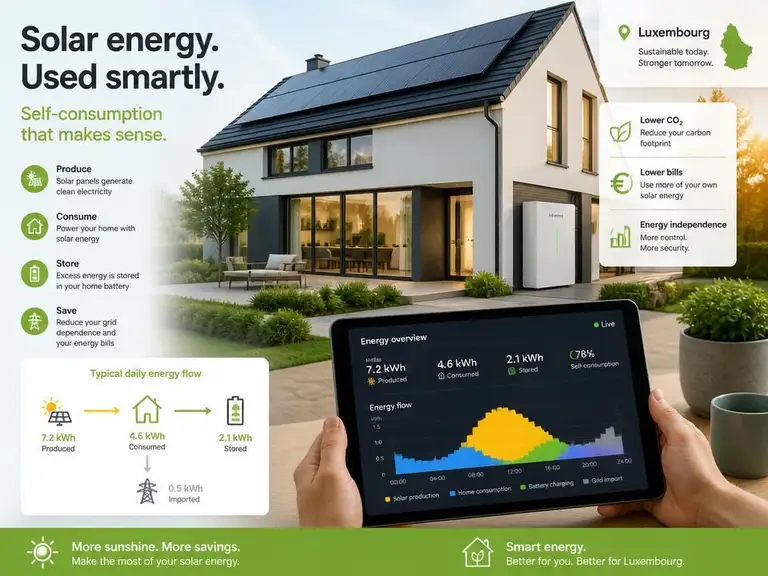
Where a photovoltaic installation is present, a charging point compatible with smart charging can adjust its power to prioritise electricity produced on site over electricity bought from the grid, particularly during the day. This function requires communication between the inverter, the charging point and, in some cases, a home energy management unit, which should be stated in the quote if sought.
The Klimabonus Wunnen and charging infrastructure
The Klimabonus Wunnen, which replaced the former PRIMe House programme in 2022, includes a component dedicated to charging infrastructure and home energy management. The eligibility conditions, in both a house and a co-owned building, and the amounts applicable at the time of your application are published on guichet.lu; check the official sheet before starting the work.
FAQ
Frequently asked questions
Can I charge from an ordinary household socket?
Does the connection capacity need to be upgraded for a charging point?
How do you install a charging point in a shared underground car park?
Who is allowed to install a charging point?
Can a charging point prioritise electricity from my solar panels?
Is the charging point supported by the Klimabonus Wunnen?
Your home deserves better than skyrocketing bills.
70% cheaper
vs. public charging
5× faster
Than a domestic socket
+5% property value
Added property value
€500 · HEMS
Grant when ≥2 devices are connected