Klimabonus 2026 · Up to €12,250 in subsidies (€10,000 panels + €2,250 battery)
Certified solar installers in Luxembourg
Get up to 7 free quotes from local craftsmen and estimate your Klimabonus subsidies in 2 minutes.
Up to €12,250 in grants
Automatic calculation of Klimabonus PV and battery grants
100% free
A free service with no obligation for you
Authorised tradespeople
Companies holding a Luxembourg business licence and registered with the Chamber of Skilled Trades (Chambre des Métiers).
Get your estimate in 1 minute
🔒 No commitment · Reply within 24h
Online simulator
Estimate your Klimabonus grants in 30 seconds
Total grants
€5,742
Indicative amounts based on the official Klimabonus scale. Conditions on guichet.lu
Registered with the Chambre des Métiers
Our partner tradespeople hold a Luxembourg business licence and are registered with the Chamber of Skilled Trades.
100% Luxembourg-based
Vert.lu only works with companies established in the Grand Duchy — no forced cross-border sub-contracting.
Free and no commitment
You remain free to compare, negotiate or refuse any quote. No fee for homeowners.
Official information sources
- Ministry of Energy
- myenergy
- SuperDrecksKescht
- Enovos
How it works
- 1
Describe your project
Fill out our online form in just a few minutes. It's free and with no obligation.
- 2
Receive your quotes
Certified installers from your area will contact you with personalised offers, including your Klimabonus grants.
- 3
Compare and choose
Freely compare quotes, prices, and customer reviews to choose the professional that's right for you.
- 4
Installation and follow-up
Your installer takes care of everything: installation, connection, administrative procedures, and production monitoring.
Guide
Solar power in Luxembourg: what to understand before you signRead the full guide
How a photovoltaic system works
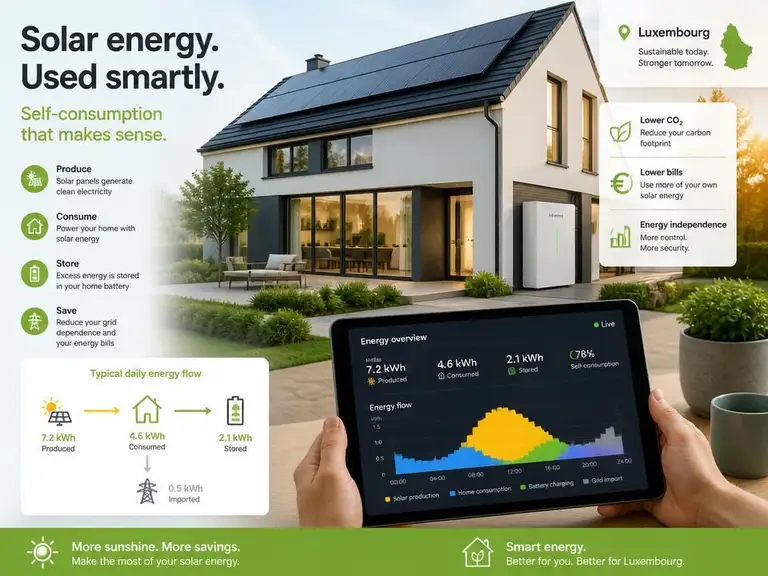
A photovoltaic system turns sunlight into direct current, which an inverter converts into the alternating current your home actually uses. The smart meter installed by the grid operator measures separately what you consume and what you feed back into the grid. Whatever your appliances use at the moment the panels are producing replaces electricity you would otherwise buy: this is self-consumption, and it is what determines a project's real return.
The hardware comes down to four elements: the modules, the mounting structure, the inverter and the cabling to the switchboard. The modules last considerably longer than the inverter, whose technical lifespan usually falls short of the panels': budget for a replacement partway through the system's life and ask the installer to spell out product and performance warranties in the quote.
Sizing correctly: orientation, area, consumption
Sizing starts from your annual consumption in kilowatt-hours, readable on your supply statement, not from the roof area available. A household that consumes little during the day will get more out of a modest, well-oriented system than a large one that feeds most of its output back to the grid.
In Luxembourg, a due-south roof with a pitch of around 30 to 35 degrees gives the best yield, but east and west orientations remain relevant: they spread production across the day, which often improves self-consumption. Shading from a chimney, a tree or a neighbouring building weighs more heavily than a few degrees of orientation; a serious installer assesses this on site rather than from a satellite photo.
Have the installer confirm in writing the capacity retained in kilowatt-peak, the expected annual output, the estimated self-consumption share and the assumptions behind the calculation. Two quotes announcing the same capacity but very different production figures rest on different assumptions: that is the point to have explained before comparing prices.
Permits, grid connection and how the work unfolds
Grid connection requires an application to the grid operator, which the installer usually files on your behalf; the operator also authorises commissioning and adapts the meter. Depending on the municipality and the type of building, a communal permit may be required, particularly for protected buildings or in a listed area: check with your municipality's technical department before ordering equipment.
A typical residential installation takes one to three working days to fit, but the full timeline — technical site visit, ordering equipment, grid connection request, installation, commissioning — usually spans several weeks. Prepare clear access to the roof and to the switchboard, and ask the company who is responsible for fall protection during the work and for restoring the site afterwards.
Klimabonus Wunnen and reduced VAT on housing
Residential solar power is supported by Klimabonus Wunnen, which replaced the former PRIMe House programme in 2022. The grant is calculated in tiers according to installed capacity and is capped; a battery paired with the system falls under a separate component. The amounts and conditions in force when you apply are published by the State: check the official sheet on guichet.lu rather than a figure quoted on a commercial site.
Work carried out on a home used as a primary residence may also qualify for the reduced VAT rate for housing, within the limits set by law. The rate applied must appear on both the quote and the invoice; ask the company for this explicitly.
Free, independent energy advice is available from Klima-Agence: it is worth consulting before starting a project that combines panels, a battery and a heat pump, since the order of the works affects both the grants and the sizing of the system.
Choosing an installer and comparing quotes
Check that the company holds a business permit for the relevant activity and carries professional liability insurance. The official register of installers lets you verify this; our company profiles summarise the public information available.
Compare quotes on the same scope: capacity, brand and model of the modules and inverter, mounting structure, cable length, electrical protection devices, scaffolding, grid connection procedures, commissioning, warranties and timelines. A lower price that excludes scaffolding or administrative steps is not actually a lower price.
Be wary of yield figures given without stated assumptions, of discounts valid "today only", and of large deposits requested before any technical site visit. A company that takes the time to measure, explain and put things in writing is one that will come back if something goes wrong.
How vert.lu puts you in touch
You describe your project in a few minutes: type of home, roof, consumption, desired timeframe. We pass the request on to companies in our directory whose trade and coverage area match, and those available get in touch to arrange a visit. You remain free to compare, negotiate or decline; the service is free for homeowners and comes with no obligation.
FAQ
Frequently asked questions
What capacity does a house in Luxembourg need?
Is a battery essential?
What support exists for photovoltaic systems?
Is a communal permit required?
How long does the installation take?
What should a good solar quote include?
Your home deserves better than skyrocketing bills.
2 994
Companies listed in the directory
Free service
No cost or obligation
Up to 7 quotes in 48h
Compare and choose freely