
Home battery: is it worthwhile in Luxembourg?
With Klimabonus support and electricity around €0.25/kWh, a home battery in Luxembourg has moved from comfort accessory to an investment you can actually compute. Here is how it works, the typical figures, the payback calculation and the cases where storage does not pay for itself.
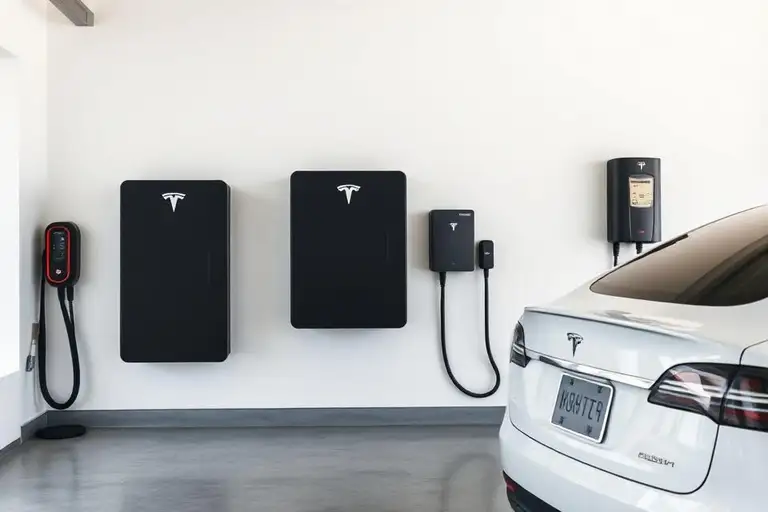
How home batteries work
A home battery stores the solar energy produced during the day and releases it in the evening and at night, when household demand peaks. Without storage, a Luxembourg home consumes only 25 to 35% of its own production directly; the rest is exported. With a properly sized battery, self-consumption typically rises to 70-80%.
Technically the installation adds a hybrid inverter (or a second, battery-side inverter), an energy management system and usually an extra meter. The unit sits in a garage or a ventilated technical room and takes up about the space of a small cabinet.
What capacity should you choose?
The most reliable rule of thumb starts from evening and night-time consumption, not from panel output. For a household using 4,000 to 5,000 kWh a year, a 5 to 8 kWh battery covers most of the night-time demand. Beyond 10 kWh, the extra capacity is only genuinely used with a heat pump, an electric car charged at home, or a large family.
Oversizing costs twice: at purchase and through unused cycles, because a battery that is never emptied is not working. Ask the installer for an hourly simulation over a full year rather than a rule-of-three estimate.
Available subsidies
Klimabonus 2026 includes a dedicated subsidy for home batteries, which stacks with the PV subsidy. It is calculated from the capacity (formula Q × (500 − 500/18 × Q) €) and reaches its €2,250 cap from 9 kWh, materially shortening the payback period.
Conditions cover the technology, the usable capacity and the coupling to a declared photovoltaic installation. The application goes through MyGuichet.lu with an itemised invoice and technical data: request those documents at handover, not six months later.
Profitability calculation
Take a Luxembourg home with an existing PV system, electricity at €0.25/kWh and a 10 kWh battery:
- Additional self-consumed energy: roughly 2,500 to 3,200 kWh per year.
- Annual saving: about €600-800, less the export revenue forgone.
- Installed cost: about €8,000 to €11,000 depending on brand and integration with the existing inverter.
- After the Klimabonus (€2,250): roughly €6,000 to €9,000 net.
Payback therefore usually lands between 6 and 9 years, against a warranted life of 10 to 15 years (often 6,000 to 10,000 cycles). Rising electricity prices improve the case; heavy daytime consumption weakens it.
What a battery does not do automatically
Two misconceptions come up repeatedly. First, a standard battery does not keep the lights on during a grid outage: without a backup function and a dedicated circuit, the system shuts down like the rest of the house. If outage resilience matters to you, ask explicitly for the option and its cost.
Second, a battery does not increase solar production; it shifts consumption in time. If your roof is under-equipped or heavily shaded, adding modules pays better than adding storage.
Heat pumps and EVs: the real accelerator
The most favourable case in Luxembourg is a household with a heat pump or an electric vehicle charged at home. Annual consumption then rises from about 4,500 kWh to 7,000-10,000 kWh, mostly in the evening and at night, exactly when the battery discharges.
In that configuration the battery cycles nearly every day of the year and payback often drops below seven years. Conversely, in a home occupied during the day with low evening demand, the gap against a system without storage stays small.
Lifetime, warranty and safety
Lithium iron phosphate (LFP) batteries now dominate the residential market: they tolerate daily cycling well and behave better thermally than NMC chemistries. Check three figures in the quote: usable (not gross) capacity, the number of warranted cycles, and the residual capacity guaranteed at the end of the warranty (often 70 to 80%).
On installation, insist on a ventilated location, overheating protection and compliance with Luxembourg electrical rules. Commissioning should be documented and monitoring available through an app.
Our recommendation
A home battery is particularly worthwhile with high evening consumption, an electric vehicle or a heat pump, or a wish for greater energy independence. If your consumption is modest and mostly daytime, optimise self-consumption first (scheduling the washing machine, hot water tank or charging) before investing in storage.
In every case, ask for a personalised study with an hourly simulation: it is the only way to know whether the battery pays for itself in your home, with your consumption profile.
FAQ
What battery capacity suits a home in Luxembourg?
For 4,000 to 5,000 kWh a year, 5 to 8 kWh is usually enough. Beyond 10 kWh the capacity is only genuinely used with a heat pump or an electric car.
Does a home battery work during a power cut?
Not automatically. It requires a backup function and a dedicated circuit, usually a paid option. Without it, the system shuts down like the rest of the house.
What is the payback of a battery in Luxembourg?
With the Klimabonus and electricity around €0.25/kWh, payback is usually 6 to 9 years, and often under 7 years with a heat pump or an electric vehicle.