
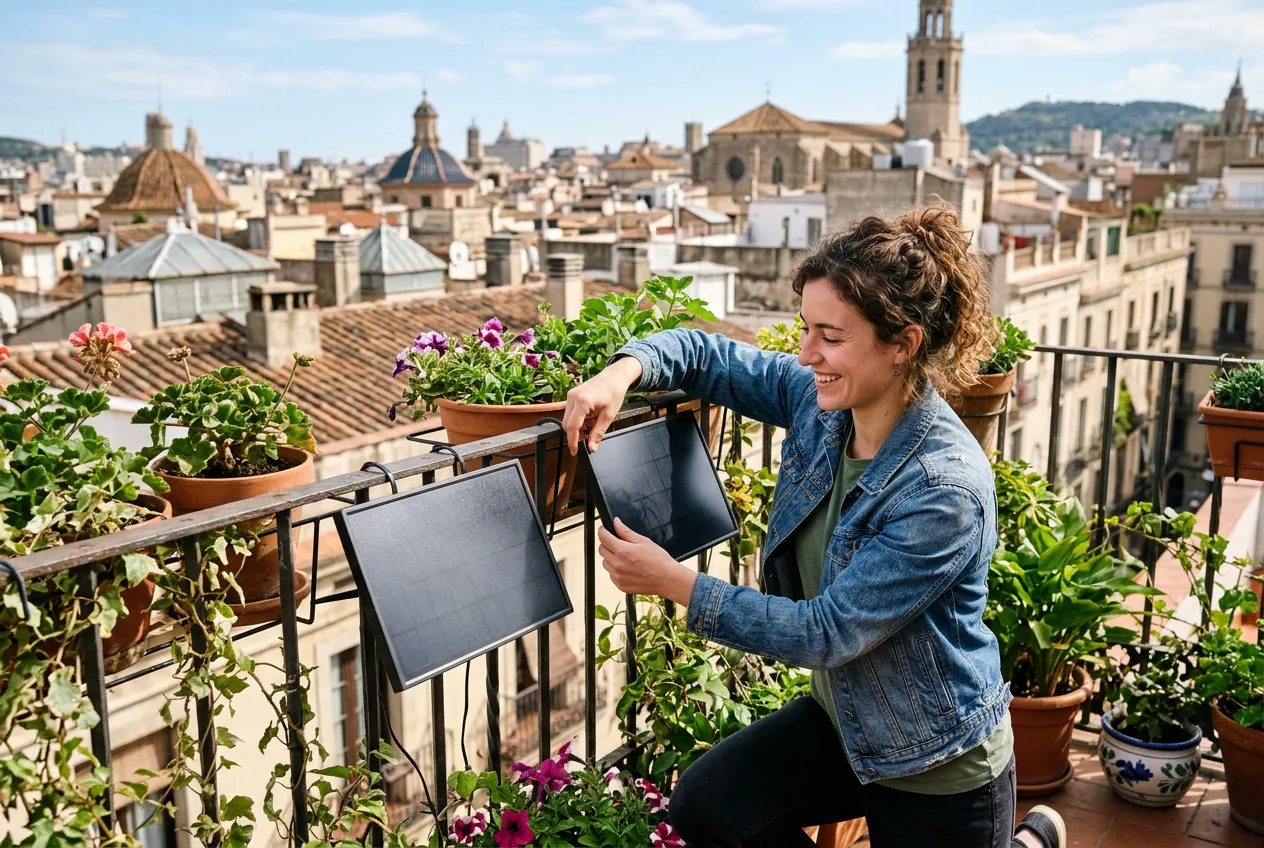
Is a balcony solar kit allowed in Luxembourg?
Yes, within a clear limit: 799 W of inverter power per dwelling unit. That is the rule written into the technical connection conditions shared by Luxembourg's grid operators, Creos first among them (version 2023.1). In an apartment building, each flat can therefore have its own kit, as long as the total of all generating systems in the building does not exceed 30 kVA.
A balcony kit (Balkonkraftwerk) usually means two modules of about 400 Wp each, a micro-inverter and a cable that plugs into a socket in the home. The electricity produced is used on site first. The surplus goes into the grid, unpaid.
What the technical rules and the municipalities require or recommend:
- A certified inverter (VDE standard or EN 50549) and CE-marked modules. Total module power may exceed 800 Wp, the inverter does the capping.
- A residual-current device on the circuit, and a line able to take the feed-in. Grid operators recommend having it checked in advance by an approved electrician.
- A suitable socket. A Wieland-type plug is not mandatory, but it is recommended for safety.
- Solid fixing. A 20 kg module torn off a railing in a storm is a real danger.
How much does a kit cost and how much does it produce?
Expect €250 to €700 for a two-module kit bought in a shop, and more like €700 to €1,500 fitted by a professional with a dedicated socket or circuit. On the other side, an 800 Wp kit produces in the order of 400 to 750 kWh a year depending on orientation and tilt.
| Location | Indicative annual output | Verdict |
|---|---|---|
| Tilted mount at 30°, due south | 700 to 750 kWh | ideal |
| Vertical railing, due south | 500 to 600 kWh | good |
| Vertical railing, east or west | 350 to 450 kWh | fair |
| North, or shade at noon | under 250 kWh | forget it |
Orders of magnitude for 800 Wp in Luxembourg, unshaded unless stated.
The classic trap is the vertical railing. A module standing upright loses a good share of its output compared with a tilted one. If your building rules allow it, a tilted bracket is often worth more than pricier modules.
VAT is also worth a question to the seller. The super-reduced 3% rate covers the supply and installation of panels on a private dwelling; a kit sold in a DIY superstore is often charged at the standard 17% rate. On €600, the difference exceeds €70.
Does Klimabonus fund a balcony kit in 2026?
No. The Klimabonus 2026 scheme requires a peak power of at least 2 kW for the solar grant, and an 800 Wp balcony kit is far from it. It also requires a system mounted on the roof or façade, run in self-consumption mode, with the feed-in payment waived.
That is a real change. In 2023, the State covered up to 62.5% of the cost excluding VAT of a kit fitted by a professional, capped at €1,562.5 per kWp. Between late 2024 and late 2025, it was still 50%, up to €1,250 per kWp. Anyone who read those figures in an old municipal leaflet may be in for a nasty surprise.
Two routes remain:
- Municipalities. Some still support balcony kits, sometimes generously. Esch-sur-Alzette, for example, offered fitted kits for a few hundred euros through its Solar Esch project. Amounts and conditions vary widely from one municipality to another: call your technical department before buying.
- Go up to 2 kWp. On a house, garage or carport, a small 2 kWp system unlocks the official formula P × (1,155 − 1,155/35 × P), i.e. about €2,178 in grant. More power, more grant, and a far lower price per kWp than a single kit.
Is a balcony kit really profitable?
Yes, if it is well oriented and you use power during the day. Every self-consumed kWh saves you buying one from the grid, about 22 cents of variable charge. Every kWh fed in, on the other hand, earns you nothing.
| Situation | Self-consumed per year | Savings per year | Payback on a €400 kit |
|---|---|---|---|
| Due south, tilted | about 450 kWh | about €100 | about 4 years |
| Due south, vertical | about 360 kWh | about €80 | about 5 years |
| East or west, vertical | about 280 kWh | about €60 | 6 to 7 years |
Indicative estimates, 2026 electricity price, no battery or municipal grant.
The key is base load: fridge, internet box, ventilation, devices on standby. It runs around the clock and absorbs part of the output. Run the washing machine and dishwasher at noon rather than in the evening and the self-consumed share climbs.
Over the 20 to 25 year life of the modules, a well-placed kit pays for itself several times over. Badly placed, facing north or behind a tree, it will never pay back anything. Small batteries for balcony kits often lengthen the payback instead of shortening it: do the maths before you are talked into one.
Tenant or co-owner: who has to agree?
Almost always someone other than you. A tenant needs the landlord's written consent before any installation, as the guides published by municipalities point out. Without it, the landlord can demand removal.
In a co-owned building, the issue is the façade. The railing and the building's external appearance are generally common parts, even if the balcony is for private use. Anything that changes how the façade looks therefore goes, in principle, through the general meeting of co-owners. Read your co-ownership rules and ask the managing agent before buying, not after.
Three arguments help to get a yes:
- A discreet model, matt black, not sticking out beyond the railing.
- Certified fixing, fitted or checked by a professional, which reassures neighbours about the risk of falling.
- A collective approach. If several neighbours are interested, a shared system on the roof, with the electricity split between flats, can earn much more. Then the Klimabonus grant becomes possible again.
Mind the insurance too: tell your home insurer about the installation. Damage caused by a badly fixed module must be covered.
How do you install a balcony kit without mistakes?
Six steps, in this order:
- Check the location. South, south-east or south-west, with no shade between 11 am and 3 pm. Facing north, give up.
- Get the approvals. Landlord if you rent, general meeting or managing agent if you co-own, possibly the municipality if the façade is protected.
- Apply for the municipal grant before buying. Some municipalities require fitting by a professional or a specific model.
- Choose a compliant kit. Inverter of 799 W at most with a conformity certificate, CE modules, brackets suited to your railing.
- Have the wiring checked. An approved electrician checks the line and the residual-current protection and, if needed, fits a dedicated socket.
- Inform the grid operator and your insurer. A simple notice to Creos or your municipal network, and one more line in your insurance policy.
And if your house has a free roof, ask yourself the real question: a balcony kit remains a top-up. A 4 to 6 kWp system, subsidised by Klimabonus, produces eight to ten times more. Our partner contractors can price both options for you.
Frequently asked questions
What is the maximum power of a balcony kit in Luxembourg?
799 W of inverter power per dwelling, under the grid operators' technical connection conditions. The modules may total slightly more, the inverter caps the feed-in.
Does a balcony kit qualify for Klimabonus in 2026?
No. The Klimabonus 2026 solar grant requires at least 2 kW of peak power. Some municipalities still support balcony kits: check before buying.
Do you have to register a balcony kit with Creos?
The formal notification and approval procedure covers systems from 0.8 kW. For a 799 W kit, inform Creos or your municipal network anyway and have the line checked by an approved electrician.
How much does a balcony kit save per year?
In the order of €60 to €100 of avoided electricity for a well-oriented 800 Wp kit, at 22 cents per kWh. Surplus fed into the grid is not paid for.
Can you install a balcony kit in a co-owned building?
Yes, but the façade and railing are generally common parts. Anything that changes the external appearance goes, in principle, through the general meeting; a tenant also needs the landlord's written consent.
One price means little without a second
One request. Up to 7 quotes from Luxembourg tradespeople. You pay nothing, you sign nothing.
Request my quotesOfficial references
guichet.lu, Klimabonus 2026 : aide pour les installations techniques (photovoltaïque, puissance minimale 2 kW) · Klima-Agence, conseil en énergie indépendant · myenergy, informations sur l'énergie solaire · Administration de l'environnement