
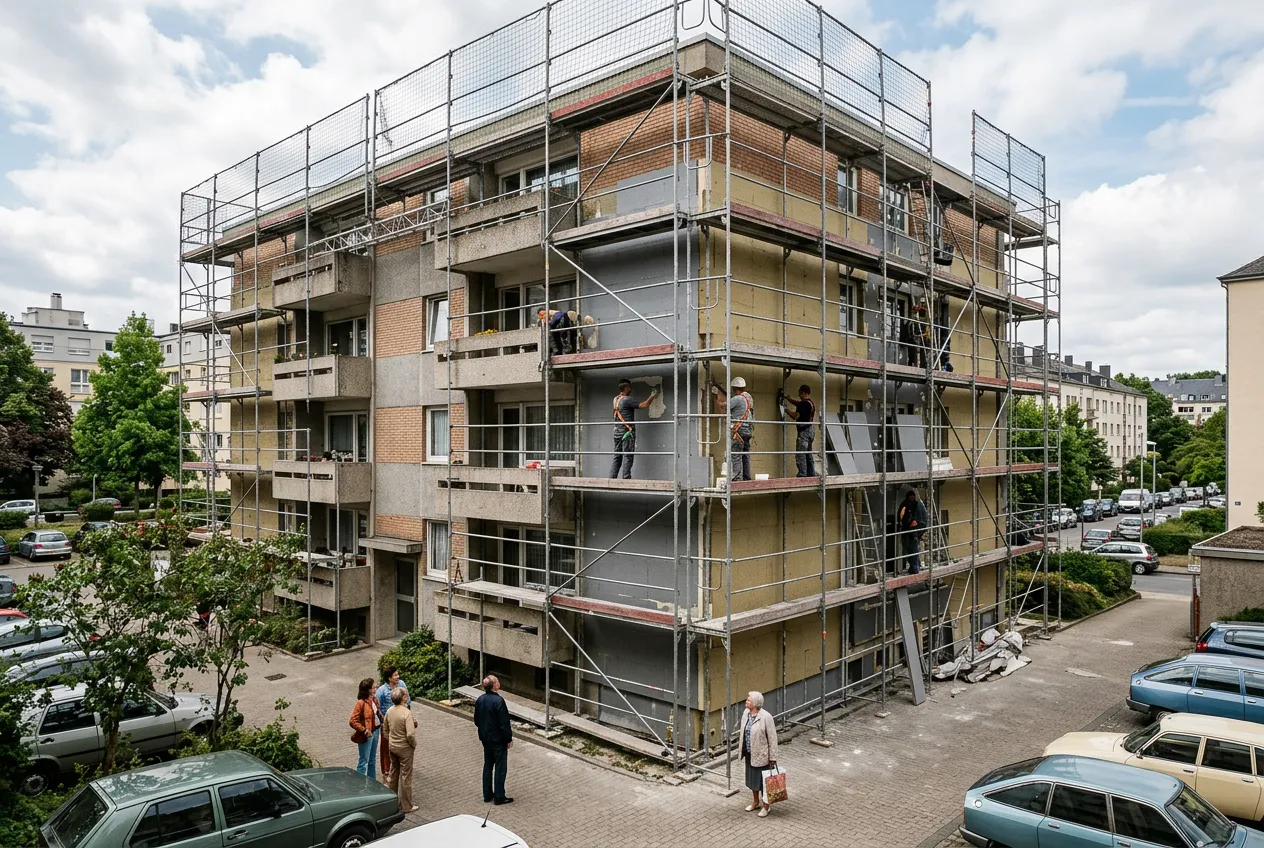
Which Klimabonus grants can a co-ownership receive in 2026?
The same amounts per m² as a single-family house, applied to the whole envelope of the building. Klimabonus 2026 subsidises the facade, roof, cellar ceiling, windows and ventilation of a residential building more than 10 years old, on the basis of an approved energy advice. The amounts in brackets apply if the request for approval in principle is filed between 1 January 2026 and 30 June 2027 and the invoice is issued before 31 December 2030.
| Element (mineral insulation, standard II) | Base grant | Ecological insulation |
|---|---|---|
| Facade or roof | €70 (80) per m² | €100 (120) per m² |
| Ecological facade with cladding | not applicable | €115 (140) per m² |
| Cellar ceiling or wall against unheated space | €35 (40) per m² | €50 (60) per m² |
| Windows and French windows | €70 (80) per m² | €70 (80) per m² |
| Ventilation with heat recovery | €60 (70) per m² of reference area | same |
The more demanding standard I pays more; interior-only insulation is reduced by 25%.
Add the energy class bonus on envelope measures (+20% for reaching class C, +30% for class B, +50% for A or A+, provided at least two thermal insulation classes are gained) and the energy advice grant: €2,000 for a residence of two flats, plus €60 per additional flat, capped at €3,000 (€2,500, €75 and €3,750 during the transitional period). Shared technical installations, a heat pump or photovoltaics on the roof, fall under a separate grant that can be combined.
Who decides on the works, and with which majority?
The general assembly, by a majority of the votes of all co-owners, not only those present. That is the decisive change of the law of 30 June 2022, which amended the law of 16 May 1975 on co-ownership: energy renovation works, infrastructure for technical ducts and renewable energy production or storage installations in the common parts are now voted with this majority. Before, three quarters of the votes were often needed, even unanimity for some improvements.
In practice, in a building of 10 lots with equal shares, co-owners representing more than 500 thousandths must vote in favour, whether in the room or represented by proxy. An absentee therefore counts as a no. The syndic convenes the meeting, puts the item on the agenda with the quotes and the energy adviser's report, and writes the minutes. Those minutes are not a detail: the Guichet unique des aides au logement accepts them as proof of the collective decision for the Klimabonus application, instead of individual proxies from each co-owner.
Improvement works that are not energy-related, a lift or an extra storey for example, remain subject to the three-quarters majority. Hence the value of describing the project properly in the convening notice: an insulated facade is an energy renovation, a decorative refresh is not.
How do you finance the part left to pay?
First with the works fund, mandatory in every co-ownership since 1 August 2023. The minimum annual contribution depends on the building's energy class on its energy performance certificate, applied to the energy reference area.
| Energy class of the building | Minimum contribution | Example for an 80 m² flat |
|---|---|---|
| A+ to C | €3 per m² per year | €240 per year |
| D and E | €5 per m² per year | €400 per year |
| F to I, or no valid certificate | €6 per m² per year | €480 per year |
The assembly may vote more, never less. The sums are attached to the lot and stay with the co-ownership when a flat is sold.
This fund is rarely enough for a complete facade, but it pays for the energy advice, the studies and the first works, and it reassures the bank for the rest. For a co-ownership of ten flats insulating facade and roof, the order of magnitude is €15,000 to €30,000 per lot before grants, depending on surface and materials; Klimabonus often refunds 30 to 45% of it. Co-owners can then finance their share individually, and the 3% VAT applies on request to renovation works on dwellings more than 10 years old occupied as a main residence.
One point often forgotten: the Klimabonus grant is calculated for the building, then split between co-owners according to the charge allocation key. A landlord owner is entitled to it just like an occupant.
What is the procedure, step by step?
Seven steps, in this order, or the grant is lost:
- Have an energy advice voted. The syndic appoints an approved energy adviser. Their report costs the measures, class by class, and conditions everything that follows.
- File the request for approval in principle with the Guichet unique des aides au logement, before any start of works. Between 1 January 2026 and 30 June 2027, it opens the right to the increased amounts.
- Gather the collective documents: annex form COLL-2026, PROC-2026 proxies from each co-owner or the general assembly minutes drawn up by the syndic, and the list of flats with their energy reference area excluding common parts.
- Vote the works and the quotes by a majority of the votes of all co-owners, with clear financing: works fund, calls for funds, loan.
- Entrust the works to approved companies, each measure with a separate invoice. An adviser can check the conformity of the offers (€100 per measure, €400 maximum) and of the site (€250 per measure, €1,000 maximum), both subsidised.
- Have the energy performance certificate drawn up after the works: it triggers the class bonus.
- Request payment within four years after 31 December of the invoice year. Invoices remain eligible until 31 December 2035 if approval in principle was requested before the end of 2030.
Which pitfalls cost a co-ownership dearly?
Five mistakes come up in almost every refused or reduced file.
- Starting before the approval in principle. Scaffolding erected before the Guichet unique replies cancels the grant on the whole measure. No exception.
- Choosing a classic fossil insulation. Polystyrene without recycled content is no longer subsidised on facades and roofs; you need at least 50% recycled material, a mineral or an ecological insulation. The cheapest quote can therefore be the most expensive.
- Replacing the windows before the walls. Windows are only subsidised if the exterior wall or roof reaches a U-value of at most 0.85 W/m²K, or if the dwelling has controlled mechanical ventilation. And in many co-ownership rules, windows are private parts: each owner decides and pays, which complicates a grouped project.
- Forgetting the absentees. With a majority calculated on all co-owners, ten per cent of proxies not returned is enough to sink the vote. The syndic must chase before the meeting, not after.
- An incomplete file. Without the list of reference areas per flat and signed minutes, the application goes back into the queue, and the transitional deadline of 30 June 2027 waits for nobody.
How much can a co-ownership actually recover?
Often a third of the cost of the works, sometimes close to half. Take a 1970s building of eight flats, class F, with 600 m² of facade, 300 m² of roof and 200 m² of windows, renovated with mineral insulation to standard II during the transitional period.
| Item | Indicative cost | Klimabonus 2026 grant |
|---|---|---|
| Facade 600 m² (external insulation) | about €120,000 | €48,000 |
| Roof 300 m² | about €54,000 | €24,000 |
| Windows 200 m² (triple glazing) | about €160,000 | €16,000 |
| Subtotal | about €334,000 | €88,000 |
| Class B bonus (+30% on the envelope) | + €26,400 | |
| Energy advice (€2,500 + 6 × €75) | about €3,500 | + €2,950 |
| Total | about €337,500 | about €117,000 |
Costs are orders of magnitude on the Luxembourg market; grants are those of the 2026 scheme for a request for approval in principle filed before 30 June 2027.
That is about 35% of the works refunded, €42,000 per flat before grants and €27,500 after. Add the municipal grant, which exists in many municipalities, and a collective heating bill that falls for good. A building that goes from F to B also sells and lets better: the energy performance certificate is mandatory in every advert.
If the co-ownership wants to go further, a shared heat pump or a photovoltaic installation on the roof falls under the technical installations grant, which can be combined with all of the above. Our partner contractors used to apartment buildings know how to cost both parts in a single file.
Frequently asked questions
Which majority is needed to vote facade insulation in a co-ownership?
A majority of the votes of all co-owners, present or not, since the law of 30 June 2022. Energy renovation works and renewable energy installations in the common parts fall under this majority; other improvements remain at three quarters.
Does a co-ownership receive the same Klimabonus grants as a house?
Yes, the same amounts per m² of insulated element, the same 20 to 50% class bonus and an energy advice grant of €2,000 plus €60 per flat, capped at €3,000, increased during the transitional period until 30 June 2027.
How much must be paid into the mandatory works fund?
At least €3 per m² per year for a building in class A+ to C, €5 for classes D and E, €6 for classes F to I or without a valid certificate. The assembly may vote more.
Can works start before the Guichet unique replies?
No. Approval in principle must be obtained before any start of works, otherwise the grant is lost for the measure concerned. Build this delay into the assembly's calendar.
Are a flat's windows subsidised if the facade is not insulated?
Only if the exterior wall or roof already reaches a U-value of at most 0.85 W/m²K, or if the dwelling has controlled mechanical ventilation. Otherwise, insulate the facade first.
One price means little without a second
One request. Up to 7 quotes from Luxembourg tradespeople. You pay nothing, you sign nothing.
Request my quotesOfficial references
guichet.lu, Klimabonus 2026 : rénovation énergétique d'un logement sur base d'un conseil en énergie · guichet.lu, Klimabonus 2026 : aide financière pour la rénovation énergétique d'un logement · guichet.lu, loi modifiée du 16 mai 1975 portant statut de la copropriété (loi du 30 juin 2022, fonds de travaux) · Klima-Agence, conseil en énergie et simulateur d'aides