
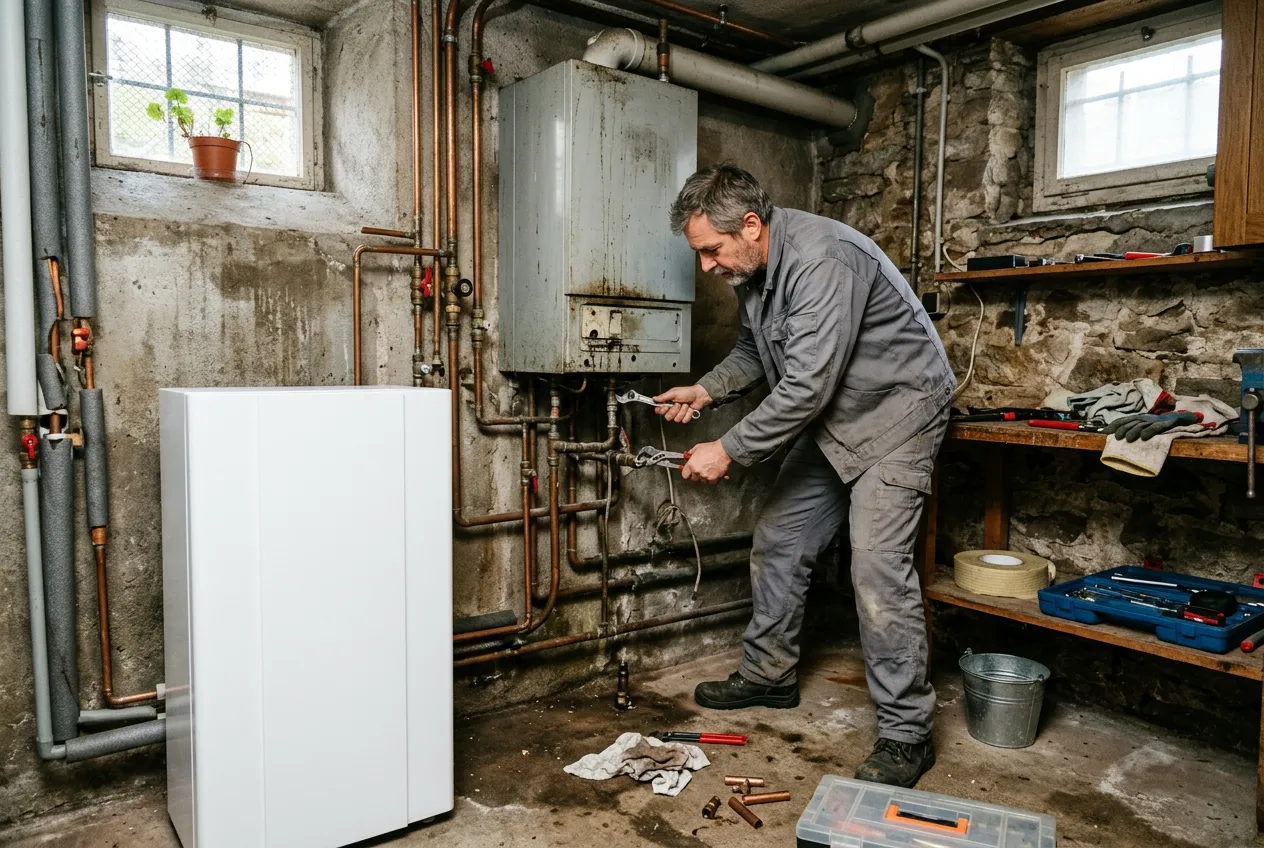
Is it still allowed to replace a gas boiler with a gas boiler?
Yes in an existing house, no in a new build. Since 1 January 2023, new residential buildings can no longer be fitted with fossil-fuel heating: the heat pump has become the reference solution there. For the existing stock, no replacement ban applies in 2026 and Luxembourg law has set no cut-off date.
That does not make gas a neutral choice. Three signals all point the same way:
- No more grants. The Klimabonus subsidises neither gas boilers, nor oil boilers, nor hybrid boilers. A new condensing boiler is paid 100% out of your pocket.
- A CO2 tax that rises every year. It reached €45 per tonne on 1 January 2026, €5 more than in 2025. For a house burning 20,000 kWh of gas, that is in the order of €180 a year, and the trend is upward.
- A European horizon. The buildings performance directive aims to phase fossil boilers out of the residential stock by 2040 to 2045. A boiler fitted in 2026 and built to last 20 years is likely to end its life under a much stricter framework.
So the real question is not "am I allowed?" but "do I still want to put €10,000 into a technology at the end of its career?".
How much does gas heating cost compared with a heat pump?
At 2026 energy prices, a properly sized heat pump heats more cheaply than gas, provided it reaches a seasonal coefficient of performance of at least 3. The Ministry of the Economy announces for 2026 an average electricity price of 25.8 cents per kWh for a typical household, State aid on network charges included. Natural gas cost on average 9.17 cents per kWh in 2025, heating oil 8.7 cents, pellets 7.5 cents.
| Energy | Price per kWh of energy | Efficiency or COP | Price per kWh of heat |
|---|---|---|---|
| Natural gas (condensing boiler) | 9.2 ct | 0.95 | about 9.7 ct |
| Heating oil | 8.7 ct | 0.90 | about 9.7 ct |
| Pellets | 7.5 ct | 0.90 | about 8.3 ct |
| Air-to-water heat pump | 25.8 ct | COP 3.0 to 3.5 | 7.4 to 8.6 ct |
| Ground-source heat pump | 25.8 ct | COP 4.0 to 4.5 | 5.7 to 6.5 ct |
2025 and 2026 average prices including all taxes, indicative efficiencies and seasonal COPs; the 2026 CO2 tax is not yet included in the 2025 averages for gas and oil.
For a house using 20,000 kWh of heat a year, the gap between a gas boiler (about €1,940) and an air-to-water heat pump at COP 3.2 (about €1,610) is around €300 to €350 a year. It grows with the CO2 tax and with a solar roof, and it melts away if your heat pump is badly set up. The real COP is decided by the flow temperature: 35 degrees in underfloor heating is the dream; 55 degrees in old radiators is the borderline case.
Which grants are available for replacing a gas boiler in 2026?
Up to €12,000 for an air-to-water heat pump and €14,000 for a ground-source system in an existing house, provided the installation replaces a fossil boiler or direct electric heating. The Klimabonus 2026 scheme pays lump sums whatever the output, and it provides a higher amount for orders placed between 1 January 2026 and 30 June 2027 with an invoice dated no later than 31 December 2028.
| Installation in an existing house | Base amount | Order before 30 June 2027 |
|---|---|---|
| Air-to-water heat pump, replacing a fossil boiler | €10,000 | €12,000 |
| Air-to-water heat pump, no replacement | €6,000 | €8,000 |
| Ground-source heat pump, replacing | €12,000 | €14,000 |
| Pellet boiler, replacing | €8,000 | €8,000 |
| Connection to a heat network, replacing | €8,000 | €8,000 |
| Adapting the distribution (radiators, circuits) | 50% of cost, max €2,000 | same |
| Removing and recycling an oil tank | €1,500 | €1,500 |
Amounts for a single-family house; in an apartment building, €8,000 per dwelling (€10,000 with the increase), capped at €24,000 (€30,000).
Two changes matter to you. First, the replaced boiler no longer has to be ten years old: the former age condition has gone. Second, replacing an oil boiler in a water protection zone earns an extra €2,000. Modest-income households can apply for the Klimabonus social top-up, which can go as far as doubling the grant. And many municipalities add their own aid, often between €500 and €2,000: a call to your municipal administration is worth it before signing.
Which technical conditions must be met to receive the grant?
Six conditions, all checkable on the quote. A contractor used to the Klimabonus knows them by heart; a quote that does not mention them is a warning sign.
- Performance. An air-to-water heat pump must show a COP of at least 3.1 at point A7/W35 under EN 14511; a ground-source unit, 4.3 at B0/W35. At a higher flow temperature, the threshold must be reached at that temperature.
- Meters. A dedicated electricity meter and a heat meter are compulsory: that is what allows the real COP to be checked.
- Hydraulic balancing. It must be carried out at commissioning. It is also what separates an installation using 4,000 kWh from one using 6,000.
- Buffer tank. In an existing dwelling, 30 litres per thermal kW, except for a modulating unit.
- Noise. The outdoor unit must respect the ErP label ceilings: 48 dB(A) up to 5 kW, 51 dB(A) from 5 to 12 kW, 55 dB(A) above, or 40 dB(A) at the boundary of the nearest buildable plot.
- Acceptance. The installer requests the acceptance inspection within one month of commissioning.
What budget and what net cost should you plan for?
Between €18,000 and €28,000 incl. VAT for an air-to-water heat pump installed in place of a boiler in an existing house, depending on output, the hot water tank and work on the radiators. A ground-source system with drilling sits rather between €30,000 and €45,000. These are market ranges, not quotes: only a visit by the contractor gives a reliable figure.
Take a 1990s house, 160 m², gas boiler from 2008, radiators kept. Quote for a 12 kW air-to-water heat pump with tank: €23,000. Increased Klimabonus: €12,000. Adapting three undersized radiators: €1,800, supported at 50%, i.e. €900. Municipal aid: €1,000. Net cost: about €10,900, against €10,000 to €12,000 for a new gas condensing boiler paid in full.
In other words, in 2026 the heat pump costs roughly the price of a gas boiler at purchase, then €300 to €500 less every winter. Over 15 years the gap exceeds €5,000 before even counting the rising CO2 tax.
A cash-flow point: until the end of 2026 you advance the grant and recover it after the file is processed, which often takes several months. Prefinancing, with the grant deducted directly from the invoice, extends to heat pumps for invoices dated from 1 January 2027. If you order now for a spring installation, ask your installer whether they will be listed in the prefinancing register.
Which timeline should you follow to secure the bonus?
Five steps, and one date to remember: 30 June 2027.
- Assess the house before choosing the machine. Insulation, windows, radiators: a visit from a Klima-Agence adviser is free and avoids buying 16 kW where 10 are enough once the roof is insulated.
- Compare three quotes from partner contractors before 30 June 2027. The order must be signed within this window to obtain the increased €12,000. After that, back to €10,000.
- Have it installed and accepted before 31 December 2028. The invoice must be dated no later than 31 December 2028 for the increase; otherwise the 2026 scheme runs until 31 December 2030.
- File the application on MyGuichet.lu after the works. With the invoice, the form pre-filled by the installer and the acceptance report. Maximum deadline: four years after 31 December of the invoice year.
- Apply for the municipal aid and the social top-up in parallel. Both combine with the Klimabonus and are requested separately.
One last, slightly provocative piece of advice: do not let a breakdown decide for you. A boiler that dies in January gets replaced in a hurry with whatever is available, often another gas boiler. A heat pump is planned between April and October, when contractors have time and the heating can wait.
Frequently asked questions
Are gas boilers banned in Luxembourg?
In new builds, yes since 1 January 2023. In an existing house, replacing a gas boiler with another remains allowed in 2026, but without any grant and with a CO2 tax that rises every year.
How much do you get for replacing a gas boiler with a heat pump?
€10,000 of Klimabonus for an air-to-water heat pump in an existing house, €12,000 if the order is placed between 1 January 2026 and 30 June 2027 with an invoice before 31 December 2028. A ground-source system gives €12,000 or €14,000.
Does the replaced boiler have to be a certain age?
No. The ten-year age condition of the previous scheme has gone in the Klimabonus 2026. It is enough that the heat pump replaces a fossil boiler or direct electric heating.
Is a heat pump really cheaper to run than gas?
Yes at 2026 prices if the seasonal COP reaches at least 3: about 7.4 to 8.6 cents per kWh of heat against about 9.7 cents with gas, i.e. €300 to €350 of difference a year for 20,000 kWh of heat, before CO2 tax.
Can you keep the gas boiler as a back-up to a heat pump?
Technically yes, but the grant is only paid if the heat pump runs in monovalent mode and covers at least 70% of heat demand. In most houses the gas back-up costs more than it brings.
One price means little without a second
One request. Up to 7 quotes from Luxembourg tradespeople. You pay nothing, you sign nothing.
Request my quotesOfficial references
guichet.lu, Klimabonus 2026 : aide pour les installations techniques (pompe à chaleur, chaudière, réseau de chaleur) · Klima-Agence, simulateur d'aides et conseil gratuit · Administration de l'environnement, Klimabonus · Ministère de l'Économie, prix moyens de l'énergie 2026 (communiqué de décembre 2025), cité en texte