
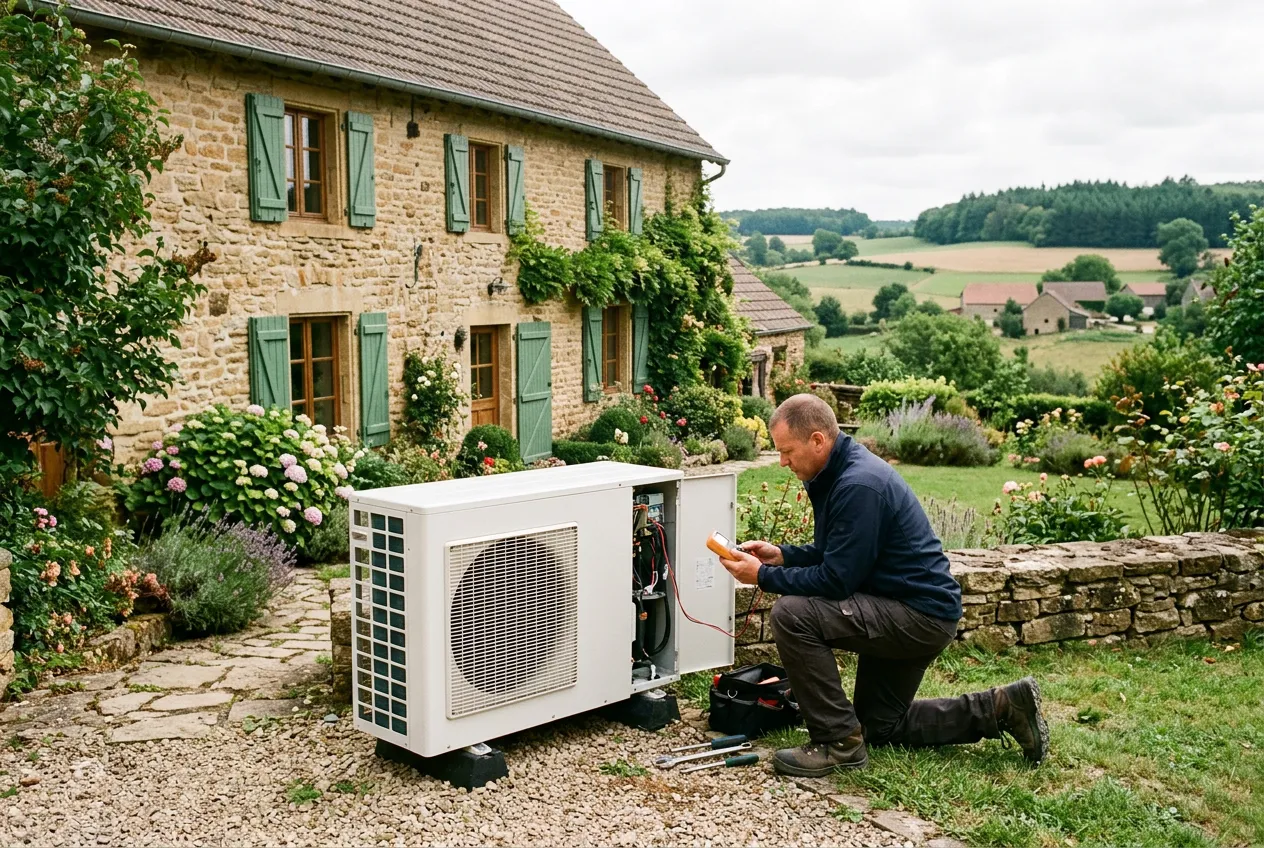
Can a heat pump heat an old house?
Yes, if the heating water temperature stays reasonable. A heat pump does not make heat, it moves it: the smaller the gap between the outside air and your radiator water, the more efficient it is. At a 35 °C flow temperature, a good air-to-water model delivers 3.5 to 4 kWh of heat per kWh of electricity. At 55 °C, it drops to around 2.5. At 65 °C, some models still manage, but the bill looks like electric heating.
So the question is not "is my house old?" but "what water temperature do my radiators need?". And there, the surprises are often good ones. Many boilers from the 1980s and 1990s are set to 70 or 75 °C out of habit, while the radiators, generously sized at the time, would heat the house at 50 °C without trouble.
| Flow temperature | Typical air-to-water COP | Cost of 1 kWh of heat at 22 ct/kWh |
|---|---|---|
| 35 °C (underfloor heating) | 3.5 to 4 | about 6 cents |
| 45 °C (large radiators) | 3 | about 7 cents |
| 55 °C (standard radiators) | 2.5 | about 9 cents |
| 65 °C (undersized radiators) | 2 | about 11 cents |
COP: orders of magnitude in real conditions, varying with model and climate. The Klimabonus minimum is 3.1 at the A7/W35 test point.
The simple rule: up to 50 °C, a heat pump pays off in an old house. Between 50 and 55 °C, it works but one or two things need improving. Above that, insulate or change a few radiators before signing.
How do you test your house for free before deciding?
Turn your current boiler down to 50 °C and live through a winter with it. It is the most reliable test there is, and it costs nothing.
In practice: on your gas or oil boiler, set the flow temperature (or the heating curve) so the water never exceeds 50 °C, then open all thermostatic valves fully. If the house stays at 20 °C through the coldest weeks of January, your radiators are big enough for a heat pump. If one or two rooms stay cool, note which ones: those are the radiators to replace, not the whole system.
Three other checks take half an hour:
- The electrical panel. An 8 to 12 kW heat pump needs a three-phase connection or a dedicated line. Most Luxembourg houses have one, but get it confirmed.
- Space outside. The outdoor unit needs a clear spot, away from bedrooms and the property line. The Klimabonus sets noise limits: 48 dB(A) sound power up to 5 kW, 51 dB(A) up to 12 kW, 55 dB(A) above.
- Space inside. Allow room for a hot water cylinder and a buffer tank (at least 30 litres per thermal kW in an existing building, except for modulating models).
A serious installer will then do a room-by-room heat loss calculation. Beware of the one who sizes by eye "like the old boiler": old boilers were almost always oversized.
Do you need to insulate before installing the heat pump?
Not necessarily the whole house, but the easy items, yes. Insulation lowers the required capacity and therefore the flow temperature: every degree gained improves efficiency by 2 to 3%.
The order that gives the best result for the least money: ### 1. The attic floor or the roof This is where most heat escapes in a house from the 1960s to 1980s. Insulating the floor of an unheated loft costs a few thousand euros and the Klimabonus 2026 pays €25 to €50 per m² depending on material and performance. ### 2. Air leaks and windows older than 25 years Seals, shutter boxes, cellar door: these small jobs gain degrees of comfort without touching the heating. ### 3. The walls, only if you are redoing them anyway An externally insulated facade transforms the house, but it is a heavy job. It is not compulsory for a heat pump.
How much does a heat pump cost in an old house, and what grant do you get?
Expect on the order of €18,000 to €30,000 incl. VAT for an air-to-water heat pump installed in an existing house, hot water cylinder and removal of the old boiler included. Geothermal costs more, often €30,000 to €45,000 with drilling, but keeps a high efficiency even in deep winter. These are 2026 market orders of magnitude: the quote depends on the model, the capacity and the state of your system.
The Klimabonus 2026 grant is a fixed amount, not a percentage:
| Situation (single-family house) | Standard grant | Increased grant (order before 30 June 2027) |
|---|---|---|
| Air-to-water HP replacing a gas or oil boiler | €10,000 | €12,000 |
| Air-to-water HP without replacing fossil heating | €6,000 | €8,000 |
| Geothermal HP replacing a fossil boiler | €12,000 | €14,000 |
| Adapting radiators or distribution | 50% of costs, max. €2,000 | same |
| Removal and recycling of the oil tank | €1,500 | €1,500 |
| Oil boiler replaced in a water protection zone | + €2,000 | + €2,000 |
The increased grant requires an invoice dated no later than 31 December 2028. Under the standard scheme, the invoice must be dated between 1 January 2026 and 31 December 2030.
Example: a 1978 house with an oil boiler, air-to-water heat pump at €24,000, three radiators replaced for €2,400 and the tank removed. Increased grant €12,000 + €1,200 + €1,500 = €14,700. Left to pay: about €11,700. Add the municipal grant, often €500 to €2,500 depending on the municipality, and the Klimabonus social top-up for modest-income households.
Which radiators need changing, and which can stay?
Keep the large cast-iron or multi-panel steel radiators, replace the small single-panel radiators under the windows of the cold rooms. That is usually three or four radiators out of fifteen, not the whole house.
A radiator gives about half its output when the flow drops from 70 to 50 °C. Cast-iron radiators in pre-1970 houses were often generously sized and take this drop well. The slim radiators of the 1990s much less so. Three solutions, from cheapest to most expensive:
- Replace with a low-temperature radiator of the same length but deeper (type 22 or 33): €300 to €800 installed per radiator, and the Klimabonus refunds 50% of the adaptation up to €2,000.
- Add a fan-assisted radiator in the coldest room: it gently blows air through an exchanger and gives two to three times more output at low temperature.
- Switch to underfloor heating on the ground floor if you are redoing the floors anyway. It is a heat pump's best partner, but not a prerequisite.
A "high-temperature" heat pump reaching 70 °C also exists. It avoids touching the radiators, but it uses noticeably more electricity for its whole life. In most cases, changing four radiators costs less over fifteen years than heating at 65 °C.
Which mistakes make a heat pump fail in an old house?
Five mistakes come up in almost every failed project, and none of them comes from the machine itself:
- Keeping the boiler mindset. A heat pump should run for long periods at low temperature, not blast for two hours in the morning. Forget 5 °C night setbacks and let the heating curve do its job.
- Oversizing. A unit that is too powerful starts and stops constantly, wears out fast and uses more. Demand a written heat loss calculation.
- Skipping hydraulic balancing. It is compulsory for the Klimabonus, and it is what guarantees each radiator gets the right flow. Without it, the back room stays cold and the temperature gets turned up to compensate.
- Neglecting noise. An outdoor unit placed under the bedroom window or against the neighbour's wall ends in conflict. The rules allow a maximum of 40 dB(A) at the neighbouring plot boundary.
- Signing without comparing. For the same capacity, quotes vary by €5,000 and more depending on the brand and the care taken with the distribution. Our partner contractors know you compare: ask them for the COP at your house's real flow temperature, not the catalogue figure at 35 °C.
Frequently asked questions
Does a heat pump work with standard radiators?
Yes, if the radiators heat the house with water at 50 °C or less. Above that, efficiency drops: at 55 °C the COP falls to around 2.5. Replacing three or four undersized radiators is often enough.
What Klimabonus 2026 grant applies to a heat pump in an old house?
€10,000 for an air-to-water heat pump replacing a gas or oil boiler, €12,000 if ordered before 30 June 2027 with an invoice before the end of 2028. Geothermal gets €12,000 to €14,000, plus €1,500 for removing the oil tank.
Do I need to insulate the house before installing a heat pump?
Not the whole house. Insulating the attic floor and fixing air leaks is often enough to lower the flow temperature. The Klimabonus 2026 accepts works in stages.
How can I tell if my house is ready without paying for a study?
Set your current boiler to a 50 °C flow, open the valves fully and spend a winter like that. If the house stays at 20 °C in January, it is ready. Note the cold rooms: those are the radiators to change.
How much does an installed air-to-water heat pump cost in an old house?
On the order of €18,000 to €30,000 incl. VAT in 2026 depending on capacity and model, hot water cylinder included. After the increased €12,000 grant, what is left to pay is often between €8,000 and €18,000 before municipal aid.
One price means little without a second
One request. Up to 7 quotes from Luxembourg tradespeople. You pay nothing, you sign nothing.
Request my quotesOfficial references
guichet.lu, Klimabonus 2026 : aide pour les installations techniques (pompes à chaleur) · Klima-Agence, simulateur d'aides · Klima-Agence, conseil en énergie indépendant · Administration de l'environnement