
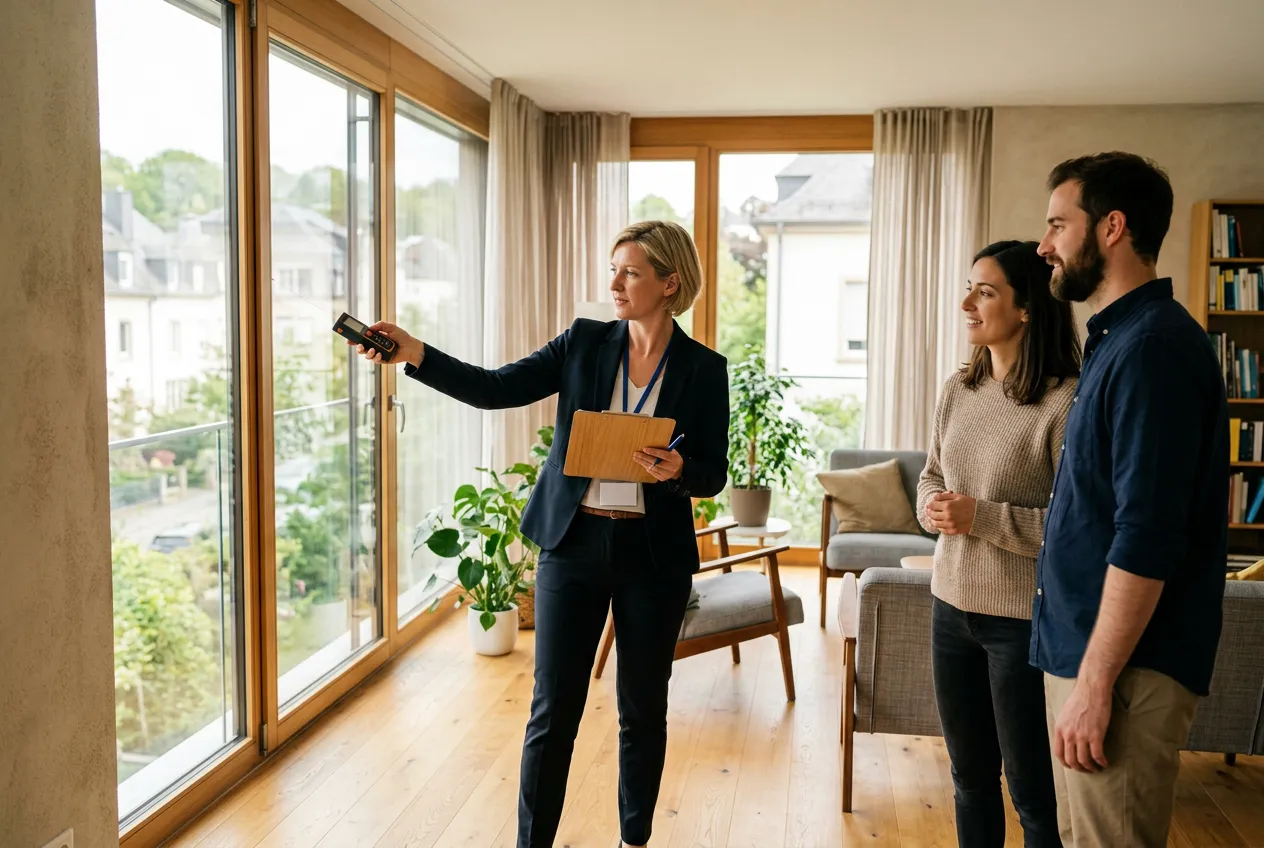
What exactly is the energy passport?
It is your home's energy identity card. Its official name is the energy performance certificate (certificat de performance énergétique, CPE), but everyone calls it the Energiepass or energy passport. An expert calculates what the building consumes under standard use, regardless of your habits. Two identical houses therefore get the same rating, even if one is heated to 19 degrees and the other to 23.
The certificate rests on three indicators, each translated into a class from A+ (the best) to I (the worst):
| Indicator | What it measures | In the listing? |
|---|---|---|
| Energy performance class | primary energy consumed (heating, hot water, auxiliaries) | yes, mandatory |
| Thermal insulation class | heating demand, so the quality of the envelope | yes, mandatory |
| Environmental performance class | CO2 emissions | no |
Source: guichet.lu, energy certificate page for residential buildings.
The insulation class is often the most telling. A 1970s house with a new boiler can show a decent energy performance and insulation rated F or G: the heating was replaced, not the walls. That is exactly what the future buyer will read between the lines.
How much does an energy passport cost in 2026?
There is no official rate: each expert sets their price, and you pay. The ranges observed in 2026 are fairly tight, though.
| Property | Indicative price incl. VAT |
|---|---|
| House up to 250 m² | roughly €400 to €600 |
| House of 250 to 500 m² | roughly €500 to €750 |
| Small building with 4 flats | roughly €700 to €1,000 for the building |
| Building with 8 flats | roughly €900 to €1,300 for the building |
Indicative ranges observed on the Luxembourg market in 2026, special cases excluded. Only the expert's written quote is binding.
What pushes the bill up: missing plans, which force the expert to survey everything on site, a house extended several times, or poorly documented heating. What brings it down: up-to-date plans, invoices for insulation works and the data sheet of the boiler or heat pump, ready on the day of the visit.
In a co-ownership, the certificate is usually drawn up for the whole building, which spreads the cost among the owners. A €1,500 quote for a standard house needs an explanation. A €150 quote, a question: will the expert really come?
When is the energy passport mandatory?
At every change of owner or tenant, if the home does not already have a valid certificate. The previous owner, meaning the seller or landlord, must have it drawn up. But selling and renting are not the only triggers. According to guichet.lu, a certificate is also required for:
- a new build subject to a building permit, requested by the developer or future owner;
- an extension of the residential building;
- a substantial alteration with an energy impact, when the modified element exceeds 10% of the surface concerned (walls, roof, windows);
- work on technical installations (heating, ventilation) costing more than €1,500 in a single-family house or more than €3,000 in a multi-dwelling building.
Two exceptions: a sale for demolition and public sales (foreclosure, auction by court order, sale by private enforcement).
And in the listing? Every sale or rental listing published in a commercial medium must state the energy performance class and the thermal insulation class shown on the valid certificate. Writing "class pending" for weeks is not a strategy: have the passport drawn up before the property goes online.
How long is the energy passport valid?
Ten years from its date of issue, shown on the certificate. A passport from 2018 is therefore no longer valid in 2028, even if nothing has changed in the house.
Three useful points:
- For a new building, the certificate drawn up on plans must be completed no later than four years afterwards with the actual energy consumption for heating and hot water. An "as built" calculation also goes to the mayor within two months of acceptance or occupation.
- For a landlord, one valid certificate covers all successive tenancies for ten years. No need for a new one with every new tenant.
- After major works, a new certificate may be required if you exceed the thresholds for alterations or technical installations. That is good news too: the new class reflects your efforts.
A passport rated G does not oblige you to do any work. The certificate informs, it does not penalise. But it tells the market what your home will cost to heat, and the market listens.
Who can draw up the passport, and how do you choose?
An architect or consulting engineer who is a member of the OAI, or an expert approved by the Ministry of the Economy. You choose freely. Specific training exists, on a voluntary basis; experts who have completed it appear on a published list, a good starting point.
Before signing, ask four questions:
- Is the visit included? A serious passport requires an on-site survey, not just photos sent by e-mail.
- Which documents are needed? Plans, year of construction, insulation invoices, heating system data sheet. The more you provide, the fairer the rating.
- What lead time? Often expect a few weeks between first contact and certificate. Plan ahead if a sale is coming up.
- Are recommendations attached? The certificate includes improvement suggestions. A good expert explains them in two sentences, with figures if possible.
Do not confuse the passport with energy advice. The passport rates the home. Energy advice, given by an approved adviser, builds a works plan and opens the door to a more generous Klimabonus grant. Klima-Agence points you to the right one free of charge.
Is a poor class a problem when selling or renting?
A problem no, costly yes. No rule forbids you from selling or renting out a home rated H or I. But buyers can read: insulation rated G signals a heavy heating bill and works to finance, and they will deduct it from their offer.
You have three options, to weigh honestly:
- Sell as is, accepting the class and adjusting the price. It is the fastest route.
- Do one or two targeted works before selling: roof insulation, new windows, heating. These are often the ones that gain one or two classes.
- Launch a full renovation with energy advice. Klimabonus 2026 reimburses this advice up to €2,000 for a single-family house (applications until 30 June 2027), and works on a home more than 10 years old can benefit from 3% VAT, on application.
Frequently asked questions
How much does an energy passport cost in Luxembourg?
There is no official rate. Expect roughly €400 to €600 for a house up to 250 m² and €500 to €750 above that. In a co-ownership, the certificate usually covers the whole building and the cost is shared.
How long is an energy passport valid?
Ten years from its date of issue. For a new building, it must be completed no later than four years afterwards with the actual heating and hot water consumption.
Is the energy passport mandatory for renting?
Yes, at every change of tenant if the home has no valid certificate. One certificate covers all tenancies during its ten years of validity.
What must a property listing state?
The energy performance class and the thermal insulation class from the valid certificate, for every sale or rental listing published in a commercial medium.
Who can draw up an energy passport?
An architect or consulting engineer who is a member of the OAI, or an expert approved by the Ministry of the Economy. You choose freely and pay their fee.
One price means little without a second
One request. Up to 7 quotes from Luxembourg tradespeople. You pay nothing, you sign nothing.
Request my quotesOfficial references
guichet.lu, faire établir un certificat de performance énergétique (Energiepass) pour un bâtiment d'habitation · guichet.lu, certificat de performance énergétique en cas de construction, rénovation ou transformation · guichet.lu, Klimabonus 2026 : aide pour la rénovation énergétique d'un logement · Klima-Agence, conseil en énergie indépendant