
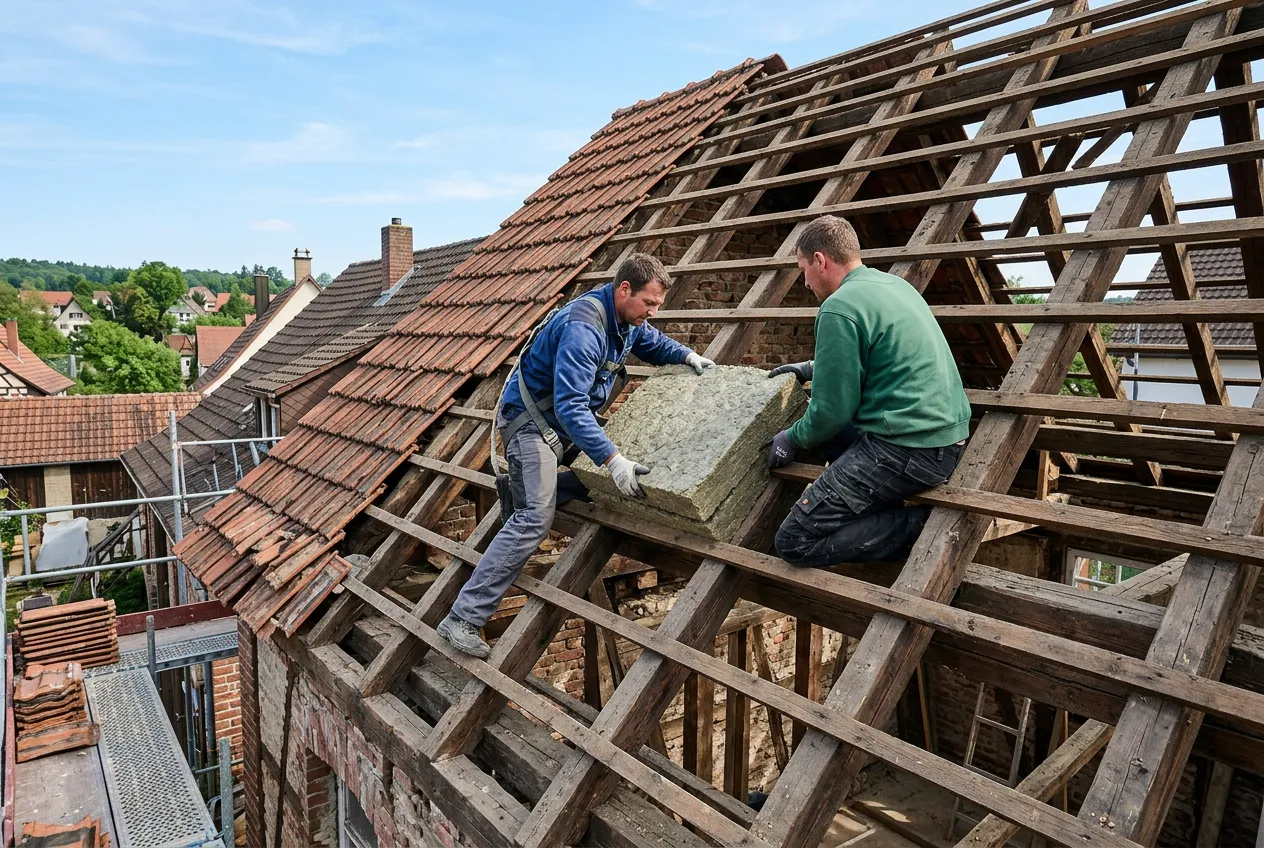
How much does roof insulation cost in Luxembourg in 2026?
Between €40 and €450 per m² depending on the technique, and that is the whole point: the right choice depends on the state of your roof covering and how you use the attic.
| Technique | When it fits | Indicative installed price, incl. VAT |
|---|---|---|
| Floor of an unheated attic (rolled or blown insulation) | Unheated, unconverted attic | €40 to €80 per m² |
| Between and under rafters, from inside | Converted attic, covering in good condition | €70 to €120 per m² |
| Sarking from outside, covering kept or relaid | Converted attic, sound structure | €150 to €250 per m² |
| Sarking with a new covering | Roof to be redone anyway | €300 to €450 per m² |
| Flat roof from outside | Flat roof, waterproofing to be redone | €120 to €200 per m² |
Ranges observed on the Luxembourg market in 2026, VAT included, 20 to 30 cm of insulation. A quote depends on access, pitch, dormers and roof windows.
For a house with 130 m² of roof, that gives about €5,000 to insulate the attic floor, €12,000 for under-rafter insulation and €25,000 to €30,000 for sarking. Before choosing the luxury version, ask yourself one simple question: do you heat your attic? If not, insulate the floor, not the roof. It is the same heat kept in for a fifth of the price.
VAT is 3% instead of 17% on insulation works for a dwelling over 10 years old used as a main residence, on request to the tax office. On a €25,000 job, the difference exceeds €3,000.
What Klimabonus 2026 grant is there for roof insulation?
€35 to €115 per m² of insulated roof, and €20 to €65 per m² for an attic floor, according to three criteria: the type of insulation, the performance reached and the date of your request.
| Insulation | Standard III | Standard II | Standard I |
|---|---|---|---|
| Roof, fossil insulation with over 50% recycled content | €35 (€40) | €45 (€50) | €60 (€70) |
| Roof, mineral insulation (glass wool, rock wool) | €60 (€70) | €70 (€80) | €85 (€100) |
| Roof, ecological insulation (wood fibre, cellulose, hemp) | €90 (€105) | €100 (€120) | €115 (€140) |
| Unheated attic floor, mineral | €25 (€30) | €35 (€40) | €50 (€60) |
| Unheated attic floor, ecological | €40 (€50) | €50 (€60) | €65 (€75) |
Amounts per m² of insulated surface. In brackets: increased rate for an approval-in-principle request filed between 1 January 2026 and 30 June 2027, invoice by 31 December 2030 at the latest.
Three top-ups of €15 per m² are added: mineral insulation with over 50% recycled content, ecological insulation from certified sustainable crops, green roof. Standard fossil insulation (non-recycled polystyrene, polyurethane) gets no grant on a roof.
Insulation fitted exclusively from the inside has its amounts reduced by 25% in the regulation: have the contractor or adviser confirm whether your under-rafter installation is affected. The building must be more than 10 years old since its building permit, and the grant is paid only once per element.
What thickness and performance do you need to reach?
At least 20 cm of insulation with a conductivity of 0.035 W/(mK) for standard III, then a U-value of at most 0.13 W/(m²K) for standard II and 0.11 for standard I. For an attic floor, standard I goes down to 0.10.
In practice, with a common mineral wool at 0.035, that means 20 cm for standard III, about 26 cm for standard II and 30 cm for standard I. With wood fibre at 0.040, add 3 to 5 cm. The 20 cm minimum thickness remains compulsory whatever standard you aim for: a very efficient but too thin insulation does not qualify.
Moving from standard III to standard II usually adds 4 to 6 cm of insulation, a few euros of material per m², for €10 more grant per m². It is almost always worth it. Standard I makes sense mainly when you are also aiming for the energy class bonus.
Ask the contractor to state the product name, its lambda, its thickness and the U-value achieved on the quote: those are the three figures the Klimabonus file checks.
Do you need an energy advice to get the grant?
No for the roof alone, yes as soon as you renovate a second element or want the energy class bonus.
For a single element, two routes are possible: entrust the works to an approved company, which files the approval-in-principle request with you, or get occasional support from an approved energy adviser. That occasional support is itself subsidised at €400, and a conformity check of the quote by an adviser at €100.
As soon as you touch two elements (roof and walls, for example), the full energy advice becomes compulsory. It usually costs €1,500 to €2,500 for a single-family house, and the Klimabonus refunds €1,700, or €2,000 at the increased rate for a request filed before 30 June 2027, without exceeding the actual cost. In return, it unlocks the class bonus: envelope grants are increased by 20% if the house reaches class C, 30% for class B and 50% for class A, provided at least two classes are gained, even in stages.
In every case, the approval in principle must be obtained before the first hammer blow. The first request can be filed until 31 December 2030, invoices are accepted until 31 December 2035, and payment is requested within 4 years of the invoice year. From 1 January 2027, prefinancing will let the company deduct the grant directly from the invoice.
How many years does roof insulation take to pay back?
Between 5 and 8 years for an attic floor, 15 to 20 years for full sarking on a roof in good condition, and almost immediately if the roof had to be redone anyway. It all depends on what you would have spent without insulating.
Take a 1975 house with 130 m² of roof, oil heating and a heating bill of €3,000 a year. An uninsulated roof accounts for 20 to 30% of heat losses.
| Scenario | Cost incl. VAT | Klimabonus grant (increased rate) | Left to pay | Annual saving | Payback |
|---|---|---|---|---|---|
| Attic floor, 100 m², mineral wool 26 cm, standard II | €6,000 | €3,500 (€4,000) | €2,000 to €2,500 | €300 to €450 | 5 to 8 years |
| Under rafters, 130 m², mineral wool, standard II | €12,000 | €6,800 to €9,100 (up to €10,400) | €1,600 to €5,200 | €600 to €750 | 3 to 8 years |
| Sarking, 130 m², certified wood fibre, standard II | €28,000 | €14,950 (€17,550) | €10,450 to €13,050 | €600 to €750 | 14 to 20 years |
Assumptions: indicative market prices; under-rafter grant of €52.50 to €70 per m² depending on whether the 25% reduction for interior installation applies; sarking €100 + €15 top-up (€120 + €15 at the increased rate). Savings based on the 2026 heating oil price, excluding future rises.
Sarking looks slow to pay back, but the table should be read differently: if your covering is 40 years old and has to be replaced, the insulation only costs you the difference, i.e. €10,000 to €15,000 extra, of which the Klimabonus pays more than half. You then insulate for 30 years and gain summer comfort on top, because an insulated roof keeps the attic bedrooms cool in July.
How do you prepare the job to get the maximum?
Six steps in the right order, because the order matters as much as the amount:
- Request the approval in principle before signing the works. An invoice dated before the approval is not refunded. The approved company or the energy adviser files the request on MyGuichet.lu.
- Compare three quotes with the same figures. Same thickness, same lambda, same target standard. A quote at €180 per m² for 18 cm is not comparable to one at €200 for 26 cm.
- Choose the insulation by looking at the net grant. Wood fibre costs 30 to 50% more than glass wool, but the grant is €30 to €40 per m² higher. The gap often closes.
- Demand airtightness. A continuous vapour barrier and careful junctions make the difference between insulation that lasts 30 years and a damp roof structure. Ask who fits the membrane and how the joints are treated.
- Think ventilation. A house made airtight without ventilation condenses. Plan at least air vents or, better, controlled mechanical ventilation, which is also subsidised.
- Group the jobs. With the roof redone, it is the moment to install solar panels without paying for scaffolding twice, and to check the municipal grant, which often adds 10 to 20% to the State grant. Our partner contractors can price both together.
Frequently asked questions
How much does roof insulation cost in Luxembourg?
On the order of €70 to €120 per m² from the inside, €150 to €250 per m² for sarking from the outside and €40 to €80 per m² for the floor of an unheated attic, VAT included, in 2026. These are indicative ranges, to be confirmed by quote.
How much does the Klimabonus 2026 pay for an insulated roof?
€35 to €115 per m² depending on the insulation (recycled fossil, mineral, ecological) and the standard reached, up to €140 per m² at the increased rate for a request filed before 30 June 2027. An attic floor gets €20 to €65 per m².
What insulation thickness is needed for the grant?
At least 20 cm of an insulation at 0.035 W/(mK) for standard III. Standard II requires a U-value of at most 0.13 W/(m²K), about 26 cm of mineral wool, standard I a U-value of 0.11, about 30 cm.
Is energy advice compulsory to insulate only the roof?
No. For a single element, an approved company can file the approval-in-principle request with you. Full advice becomes compulsory from two renovated elements and unlocks the energy class bonus of 20 to 50%.
How long does roof insulation take to pay for itself?
5 to 8 years for an attic floor, 3 to 8 years for well-subsidised under-rafter insulation, 14 to 20 years for sarking on a sound roof. If the covering had to be redone anyway, the extra cost of insulation pays back much faster.
One price means little without a second
One request. Up to 7 quotes from Luxembourg tradespeople. You pay nothing, you sign nothing.
Request my quotesOfficial references
guichet.lu, Klimabonus 2026 : rénovation énergétique d'un logement · guichet.lu, Klimabonus 2026 : rénovation d'un seul élément sans conseil en énergie · guichet.lu, Klimabonus 2026 : rénovation sur base d'un conseil en énergie · Klima-Agence, simulateur d'aides