
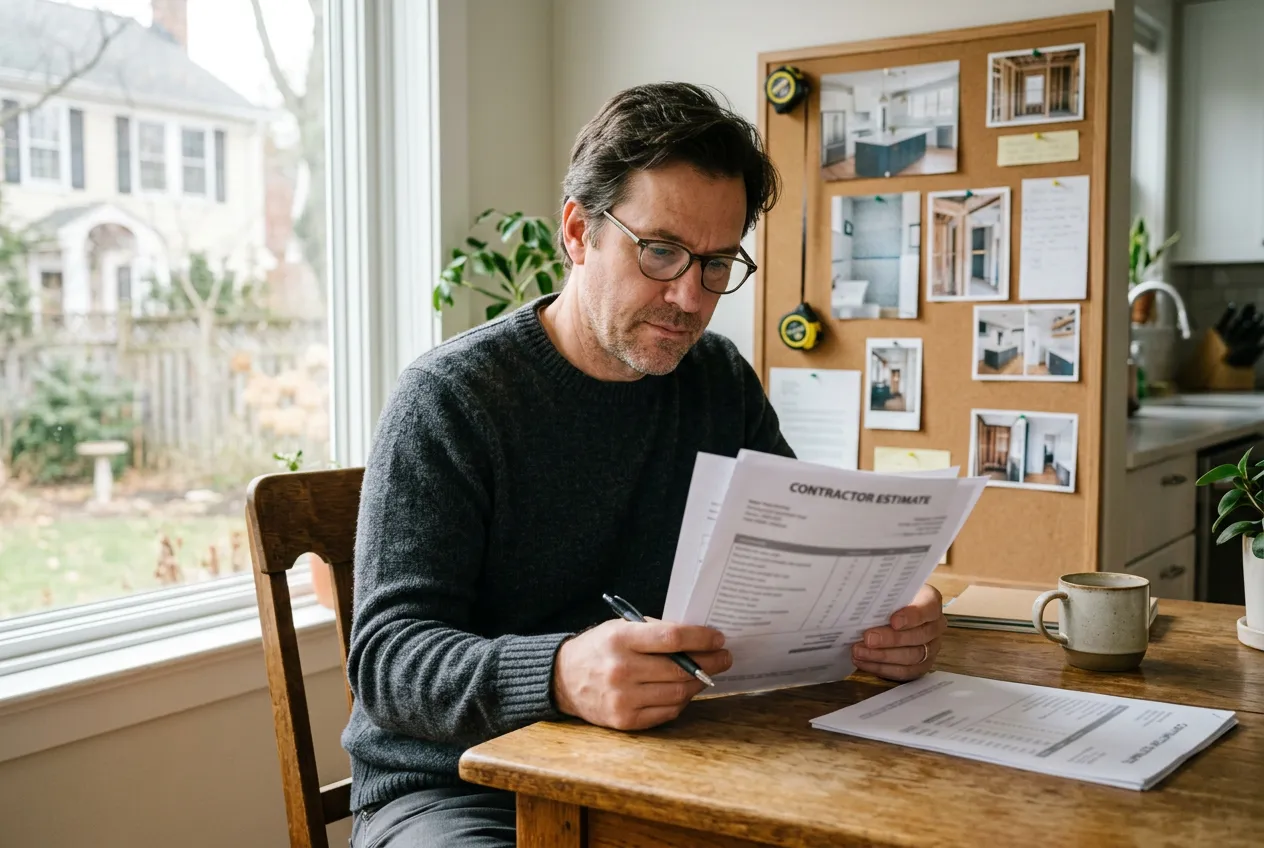
What are the 7 points to check on a quote?
The identity of the company, the content of the works, the price and its conditions, then your protections. The table below is a checklist; keep it in view as you read each offer.
| Point | What you are looking for | Warning sign |
|---|---|---|
| 1. Business licence | 2D barcode or licence number on the quote | No mention, "a colleague will invoice" |
| 2. Tax identity | LU VAT number, RCS number, address in Luxembourg | Only a mobile number |
| 3. Itemised lines | Quantities, brands, models, labour shown separately | One line "renovation package" |
| 4. VAT rate | 3% where allowed, 17% elsewhere, line by line | 3% on everything, without approval |
| 5. Payment and deposits | Schedule tied to progress | 50% or more on order |
| 6. Deadlines and penalties | Start date, duration, validity of the offer | "As soon as possible" |
| 7. Guarantees and insurance | Written acceptance, insurance certificate | No insurance mentioned |
A quote is not bad because one point is missing, but each missing point must be requested in writing before signing.
One golden rule: a signed quote is a contract. Anything not in it will be discussed later, at the moment you have the least bargaining power.
Points 1 and 2: is the company licensed and identifiable?
It must be, and the quote must show it. In Luxembourg, a craftsman needs a business licence (autorisation d'établissement) issued by the Ministry of the Economy for the trade he practises. Each licence is given a two-dimensional barcode, which must appear on letters, e-mails, the website, quotes and invoices. No code, no signed quote: it is that simple.
Then check the company's identity:
- The RCS number, which starts with B for a company and with A for a sole trader. It can be checked online in the Trade and Companies Register.
- The Luxembourg VAT number, in the form LU followed by eight digits. A foreign company without a Luxembourg VAT number cannot give you the 3% rate.
- The licensed trade. An electrician is not a heating engineer, a joiner is not a roofer. If the quote combines several trades, ask who does what, and under which licence.
These checks have a concrete stake: Klimabonus energy renovation requires an approved company, and an invoice from an unlicensed company can cost you the grant.
Points 3 and 4: are the lines itemised and is the VAT right?
A quote is read line by line, and VAT is decided on those lines. For each item, demand the quantity, the unit (m², piece, hour), the unit price, the brand and model of the equipment, and labour separate from supply. Extra costs must appear: scaffolding, waste removal, protection of the premises, travel. "Roof insulation, flat rate €18,000" makes any comparison impossible.
On VAT, three cases come up:
- 3% on renovation of a dwelling built at least 10 years before the start of the works and used as a main residence. The benefit is capped at €50,000 per dwelling, and the contractor can only invoice directly at 3% if he has obtained approval from the Registration Duties, Estates and VAT Authority before the works start, for that job.
- 3% on solar panels for a private dwelling; the battery mostly stays at 17%.
- 17%, the standard rate, for the rest. Without approval, you pay 17% and then claim a refund, provided each invoice exceeds €1,250 excluding VAT.
Points 5 and 6: are deposits, deadlines and penalties clear?
They must be quantified, dated and tied to the progress of the works. A deposit on order is normal, especially when the contractor buys equipment for you. A healthy schedule looks like this: a moderate deposit on order, an interim payment at a verifiable stage, the balance after acceptance of the works. Paying 80% before the first worker has set foot in your home means carrying the risk of bankruptcy alone.
For the Klimabonus, the deposit is not just a matter of trust:
- Solar and battery with prefinancing: deposits must not exceed 30% of the final price incl. VAT of the signed offer, otherwise prefinancing is refused.
- Insulation and heat pump with prefinancing: it is refused if the grant plus the deposit exceed the final price excluding VAT.
On deadlines, look for three dates: the validity of the offer (often one to three months), the start date and the planned duration of the works. An "as soon as possible" does not protect you. You can negotiate a late-completion penalty, for example a capped amount per day or week of delay, and a limited price-revision clause if materials are ordered late.
Finally, note the payment terms: deadline, transfer to an account in the company's name, never cash without a receipt.
Point 7: which guarantees and which insurance should you demand?
The legal guarantees exist without being written down, but their starting point, acceptance, must be. The Luxembourg Civil Code, Articles 1792 and 2270, makes the contractor liable for ten years for defects affecting major works, such as the structure, the roof or waterproofing, and for two years for minor works, such as an interior door, a floor covering or certain fittings. Both periods run from acceptance of the works.
What you should therefore obtain:
- A written acceptance, dated and signed by both parties, with the list of any reservations. Without it, proving when the guarantees start becomes difficult.
- A valid professional liability insurance certificate, and if possible insurance covering ten-year and two-year liability. In Luxembourg, this insurance is not imposed on all contractors as it is in France: one more reason to ask for it.
- The manufacturers' warranties on the equipment: warranty period of a heat pump, an inverter, windows, and who handles a breakdown.
A guarantee is only worth something if the company still exists. A long-established, insured and registered company carries more weight than the most generous promise.
Does your quote qualify for the Klimabonus?
Only if it was prepared for it, and that is decided before signing. The Klimabonus 2026 scheme has precise requirements that all go through the quote and then the invoice.
- An approved company. For energy renovation, the works must be carried out by an approved company, or supervised by an energy advisor.
- A dwelling old enough. Energy renovation targets buildings whose building permit is more than ten years old.
- One application and one invoice per item of work. Roof, facade and windows each require a separate application: ask for separate quotes or, at the very least, clearly separate lines.
- Approval in principle before the works if you want prefinancing: it is filed by an approved energy advisor or an approved craftsman, before the first hammer blow. For solar, the installer must also be listed in the prefinancing register.
- The right dates. Renovation invoices must be dated between 1 January 2026 and 31 December 2035, and the application filed within four years of 31 December of the invoice year.
The scheme even provides a €100 grant for having the offer's compliance checked by an energy advisor. A hundred euros to know whether a €30,000 quote qualifies for the grant: the most profitable deal of the whole project.
Frequently asked questions
How do you check that a contractor is licensed in Luxembourg?
Look on the quote for the 2D barcode of the business licence, which is mandatory on quotes, invoices and letters. Also check the RCS number and the Luxembourg VAT number, in the format LU followed by eight digits.
When can a quote show 3% VAT?
For the renovation of a main residence at least 10 years old, with AED approval obtained before the works, up to a benefit of €50,000 per dwelling. Solar panels for a private dwelling are also at 3%. The rest is at 17%.
What deposit is reasonable on a quote?
A moderate deposit on order, then payments tied to progress. For Klimabonus prefinancing of solar and batteries, deposits must not exceed 30% of the final price incl. VAT.
Which guarantees cover building works in Luxembourg?
The Civil Code (Articles 1792 and 2270) provides ten-year liability for major works and two-year liability for minor works, from acceptance of the works. So always have an acceptance report signed.
Can an energy advisor check my quote?
Yes. The Klimabonus 2026 scheme provides a €100 grant for having the offer's compliance checked by an energy advisor, useful before signing an energy renovation quote.
One price means little without a second
One request. Up to 7 quotes from Luxembourg tradespeople. You pay nothing, you sign nothing.
Request my quotesOfficial references
guichet.lu, TVA au taux super-réduit de 3 % sur les travaux de rénovation · guichet.lu, Klimabonus 2026 : rénovation énergétique du logement · guichet.lu, Klimabonus 2026 : aide pour les installations techniques · guichet.lu, registre des installateurs (préfinancement) · Klima-Agence, conseil en énergie indépendant