
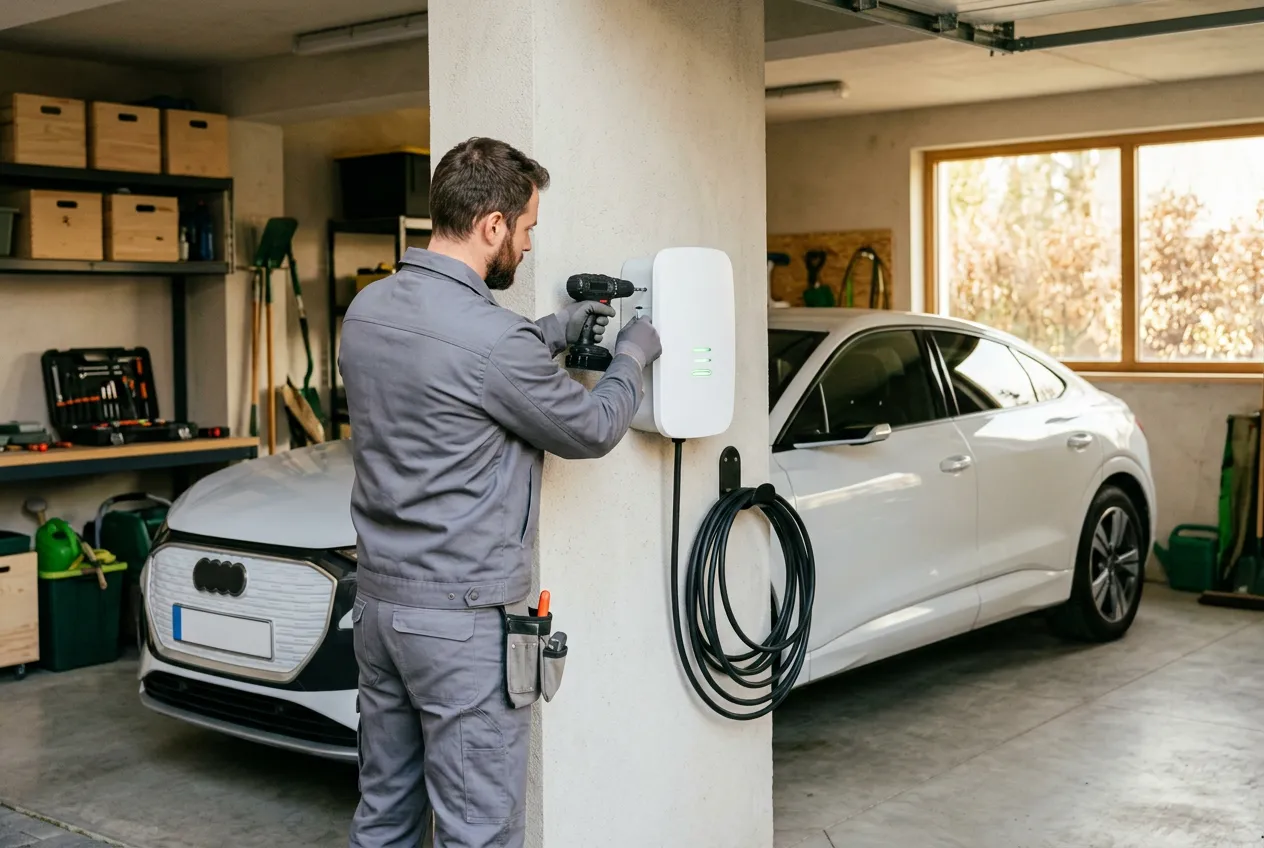
How much does an installed home charging point cost?
Between €1,500 and €3,000 incl. VAT for an 11 kW charger installed in a house, wiring included. The charger itself costs €500 to €1,500 depending on the brand and the built-in intelligence. The rest is the electrician's work: the line from the electrical panel, the protection devices, sometimes a panel upgrade.
| Situation | Indicative installed price incl. VAT |
|---|---|
| Attached garage, panel less than 10 m away | €1,500 to €2,000 |
| 15 to 30 m of cable, holes through walls | €2,000 to €2,800 |
| Electrical panel needs upgrading | €2,500 to €3,500 |
| Outdoor charging post, trench | €3,000 to €4,500 |
Ranges observed on the Luxembourg market in 2026, generally including 17% VAT; orders of magnitude, not quotes.
What blows up a quote is almost never the charger. It is the distance between the panel and the parking space, and the state of the panel. A 1980s house with a full panel can need €800 to €1,500 of extra work. Ask the electrician to price these items separately: you will know where your money goes, and these are exactly the costs the State grant takes into account.
Which power to choose: 7.4, 11 or 22 kW?
11 kW is enough in almost every case. It is the maximum AC charging power most electric cars accept, and it adds roughly 50 to 60 km of range per hour of charging. An 8-hour night easily fills a 60 to 80 kWh battery.
- 3.7 kW (single-phase 16 A): too slow, and above all not eligible. The grant requires more than 3.7 kW.
- 7.4 kW (single-phase 32 A): an option if the house has no three-phase connection.
- 11 kW (three-phase 16 A): the standard, spreading the load over three phases.
- 22 kW (three-phase 32 A): rarely useful. Few cars can use it and it puts heavy demand on the connection.
Above 7.4 kW, the grant application must include the grid operator's certificate of conformity, or a copy of the completion notice sent to it. Your electrician handles this, but check that he does.
Also think about the reference power of your connection. In the grid tariff structure, electricity drawn above that power costs more: 11.39 cents per kWh versus 7.59 cents for the volume tariff, according to the 2025 Creos tariff. A charger drawing 11 kW while the oven and heat pump run can push you over. A smart charger knows when to slow down.
How much does the 2026 private charging point grant refund?
Half the price excluding VAT, with a cap that depends on the charger. The 2026 scheme for natural persons, managed by the Environment Agency, provides in a single-family house:
- at most €750 for a "standard" charging point;
- at most €1,200 for a smart charging point;
- at most €1,400 for a charging point complying with EN ISO 15118-20:2022, if the invoice is issued by 31 December 2026 (including a €200 exceptional premium). From 2027, this cap falls back to €1,200.
| Example | Price incl. VAT | Price excl. VAT | 50% excl. VAT | Grant paid |
|---|---|---|---|---|
| Standard charger | €2,400 | €2,051 | €1,026 | €750 |
| Smart charger | €2,400 | €2,051 | €1,026 | €1,026 |
| Smart charger, major works | €3,200 | €2,735 | €1,368 | €1,200 |
| ISO 15118-20 charger, 2026 invoice | €3,200 | €2,735 | €1,368 | €1,368 |
Calculated with 17% VAT.
For the same budget, the smart charger brings up to €450 more than the basic one. Eligible costs include the charger, wiring from the panel, circuit breaker and residual-current device, panel modifications where required and shock protection. The charger must be new, installed by an accredited electrician, on a parking space in Luxembourg not open to the public. Owner or tenant of the space, you can apply.
What counts as a smart charging point for the grant?
A charger that speaks an open language. It has an integrated or external interface compatible with the OCPP protocol (Open Charge Point Protocol), version 1.6 or later, or an equivalent open protocol. Guichet.lu gives no other criterion: this is the line you need to see on the data sheet.
Why does the State pay more? Because a charger that communicates can be controlled, by an energy manager, by your supplier or by a shared system in an apartment building. In practice, it lets you:
- charge when your solar panels produce, instead of drawing from the grid;
- modulate power so you do not exceed your reference power;
- track the car's consumption, useful if your employer reimburses charging;
- stay compatible with a future shared load management system in your building.
The EN ISO 15118-20:2022 standard goes one step further. It sets up advanced communication between car and charger, with automatic vehicle recognition and, eventually, bidirectional charging. It is what unlocks the €1,400 cap this year.
How do you install a charging point in a co-owned building?
It is possible, but not on your own. In a multi-unit building, the grant is only paid for a smart OCPP-compatible charger, or for one managed by a shared smart charge management system. The aim: stop ten randomly connected chargers from overloading the building's connection.
Two grants can be combined:
| Grant | Amount | Who applies |
|---|---|---|
| Individual charger | 50% excl. VAT, up to €1,200 | The owner or tenant of the space |
| Shared management system | 50% excl. VAT, up to €40,000 per system | The building owner or the co-ownership association |
The shared system grant is granted only once per building. It covers integration of the chargers, wiring, strengthening of the connection with a dedicated e-mobility meter and fire-protection equipment, which can be the subject of a second application within 5 years. The co-ownership association can apply if most shares are held by eligible persons.
In practice, talk to the building manager first. An installation in the common parts usually requires a vote at the general meeting, according to the co-ownership rules. The smart strategy: vote for a shared infrastructure, then let each owner connect a charger the day they buy their car. Whoever installs alone today may have to replace the charger tomorrow. The building manager can also file the application on the owner's behalf, with a written mandate.
How does the installation work, step by step?
Five steps, and a deadline many people forget:
- Check the connection. Single or three-phase, reference power, free space in the panel: an electrician sees it in ten minutes.
- Compare two or three detailed quotes. Brand and model of the charger, power, OCPP compatibility, cable length, protection devices, panel work. A one-line quote does not let you calculate the grant.
- Have it installed by an accredited electrician. This is a grant condition. Above 7.4 kW, he provides the grid operator's certificate of conformity or the completion notice.
- Pay and gather the documents. Paid invoices dated between 1 January 2026 and 31 December 2030, bank details, cadastral extract or lease, form completed by the installer, charger data sheet.
- File the application on MyGuichet.lu. It goes to the Environment Agency, with the installer's form attached before sending. Careful: the right to the grant expires one year after 31 December of the invoice year. For a 2026 invoice, the deadline is therefore 31 December 2027, much sooner than the four years of the Klimabonus housing scheme.
If you have solar panels or a project under way, get the charger priced at the same time: one intervention, a shared energy manager and a car that runs on sunshine. Our partner contractors install the whole package.
Frequently asked questions
How much does an installed charging point cost in Luxembourg?
Usually €1,500 to €3,000 incl. VAT for an 11 kW charger in a house, wiring included. The price depends mainly on the distance to the panel and the state of the electrical panel.
What grant is available for a charging point in 2026?
50% of the price excl. VAT, capped at €750 for a standard charger, €1,200 for a smart OCPP-compatible charger and €1,400 for an EN ISO 15118-20:2022 charger invoiced by 31 December 2026.
Should you choose a 22 kW charger?
Rarely. Most cars charge at 11 kW maximum on AC. An 11 kW charger adds roughly 50 to 60 km of range per hour, more than enough overnight.
Can you install a charger in a co-owned building?
Yes, with a smart OCPP-compatible charger or one managed by a shared system. That shared system receives 50% excl. VAT, up to €40,000, once per building. Talk to the building manager first.
What is the deadline to apply for the grant?
The right to the grant expires one year after 31 December of the invoice year. A charger invoiced in 2026 must therefore be claimed on MyGuichet.lu by 31 December 2027.
One price means little without a second
One request. Up to 7 quotes from Luxembourg tradespeople. You pay nothing, you sign nothing.
Request my quotesOfficial references
guichet.lu, aide financière pour l'installation de bornes de charge privées (régime 2026, personnes physiques) · Administration de l'environnement, unité aides financières · myenergy, conseil en énergie et électromobilité · guichet.lu, portail officiel des démarches