
Which grant for which renewable heating in 2026?
Five families of heating are subsidised, with flat rates that no longer depend on output. The table below gives the amounts for an existing single-family house; the heat pump increase applies to an order placed between 1 January 2026 and 30 June 2027, with an invoice by 31 December 2028 at the latest.
| Installation (existing house) | Replacing a fossil boiler or direct electric heating | Without replacement |
|---|---|---|
| Air-to-water heat pump | €10,000 (€12,000 until 30 June 2027) | €6,000 (€8,000) |
| Geothermal heat pump | €12,000 (€14,000) | €8,000 (€10,000) |
| Pellet boiler | €8,000 | €4,000 |
| Connection to a heating network | €8,000 | €4,000 |
| Solar thermal, hot water only | €2,500 | €2,500 |
| Solar thermal, hot water and heating support | €4,000 | €4,000 |
| Pellet or log stove (house without central heating, replaces a stove over 10 years old) | €2,500 or 50% of the cost | same |
In apartment buildings, the amounts apply per dwelling with caps: for example €8,000 per unit and €24,000 in total for an air-to-water heat pump.
Three rules frame the whole thing. Only one "heat production" grant per dwelling: heat pump, boiler or network, not all three. Solar thermal, on the other hand, comes on top and even earns a €1,000 bonus if installed with a heat pump or a wood boiler. And invoices must be dated between 1 January 2026 and 31 December 2030, with the application filed on MyGuichet.lu within four years after 31 December of the invoice year.
Air-to-water or geothermal heat pump: which pays more?
Geothermal gets €2,000 more, but often costs €10,000 to €20,000 more to install. The highest grant is therefore not necessarily the best deal.
Air-to-water: €12,000 until 30 June 2027. This is the most common case in renovation. Expect €18,000 to €28,000 incl. VAT installed, depending on output, the hot water tank and the radiators to adapt. Typical amount left to pay: €6,000 to €16,000, before the municipal grant. The required COP is 3.1 at A7/W35; in practice, aim for a unit that still holds a COP of 2.5 at 55 degrees if you keep your radiators.
Geothermal: €14,000 until 30 June 2027. Vertical probes or horizontal collectors, required COP of 4.3 at B0/W35. Budget €30,000 to €45,000 with drilling, left to pay €16,000 to €31,000. In return, a kWh of heat costs 5.7 to 6.5 cents instead of 7.4 to 8.6 cents with air-to-water, i.e. €250 to €400 of extra savings per year for 20,000 kWh.
The extras are worth a look. Adapting the distribution (low-temperature radiators, circuits) is subsidised at 50% up to €2,000; removing an oil tank is worth €1,500; an oil boiler replaced in a water protection zone adds €2,000. And the Klimabonus social top-up can go as far as doubling the grant for a modest-income household.
Our reading: geothermal makes sense in a well-insulated house with accessible land and a 25-year horizon; air-to-water wins almost everywhere else, especially with the €12,000 bonus.
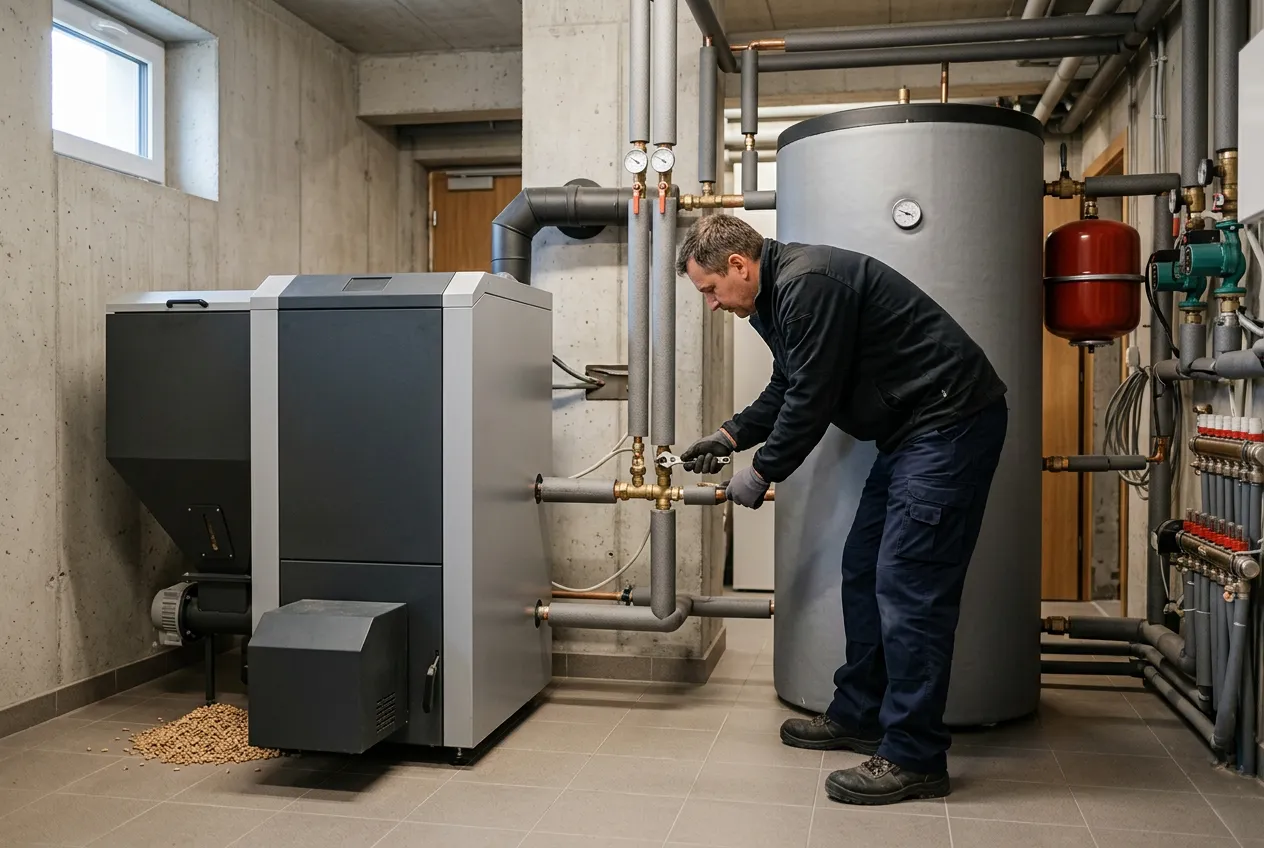
Pellet boiler: how much and on what conditions?
€8,000 if it replaces a fossil boiler or direct electric heating, €4,000 otherwise, only in an existing dwelling. A 15% bonus is added if you install a buffer tank of 30 litres per kW of rated output, i.e. €9,200 in total.
The technical conditions are strict, and deliberately so: combustion control, automatic feed and ignition, dust limited to 8 mg/m³, nitrogen oxides to 200 mg/m³, efficiency of at least 90%.
On budget, a pellet boiler with silo and tank generally costs between €20,000 and €30,000 incl. VAT installed, sometimes more if the plant room has to be fitted out. Left to pay: €11,000 to €21,000. In use, pellets cost 7.5 cents per kWh on average in 2025, i.e. about 8.3 cents per kWh of heat at 90% efficiency: cheaper than gas, slightly more expensive than a good air-to-water heat pump.
Solar thermal: a modest grant, but one you can combine?
Yes, and that is its appeal. €2,500 for a domestic hot water system, €4,000 if it also supports heating, plus a €1,000 bonus when it accompanies a heat pump or a wood boiler. Unlike the other grants in this article, it does not use up your single "heat production" grant.
The conditions: Solar Keymark certified collectors, mandatory heat meter, gross area of at least 9 m² of flat-plate collectors or 7 m² of evacuated tubes, existing dwelling whose building permit is at least ten years old.
A solar water heater for a family of four costs in the order of €6,000 to €9,000 installed; a combined hot water and heating system, €10,000 to €15,000. After the grant, solar thermal covers 50 to 60% of annual hot water needs. Profitability is decent with a pellet boiler, because it avoids running the boiler in summer; it is more debatable next to a heat pump coupled with photovoltaics, which often does the same job for less. Ask to see both options before signing.
Heating network: the option with no machine at home?
€8,000 to connect an existing house to a heating network replacing a fossil boiler, €4,000 without replacement, €5,000 per dwelling in apartment buildings with a cap of €20,000. Creating a new network linking at least two residential buildings is subsidised at €20,000 or 50% of the cost. A heat transfer station is mandatory.
The advantage is obvious: no boiler, no heat pump, no heavy maintenance, a plant room that fits in a cabinet. The drawback shows in the energy price: network heat cost 13.8 cents per kWh on average in 2025, clearly more than gas or a heat pump, because the subscription and the depreciation of the network are included in that price. Compare the total cost over fifteen years, subscription included, not just the investment grant.
The option only exists where a network runs or will run: some municipalities, new districts, housing estates supplied by a collective heat pump. Check with your municipality before investing in an individual machine you might have to disconnect in ten years.
How to choose: net cost and price per kWh of heat compared?
By putting the amount left to pay after grants side by side with the cost of heat over time. Here is the comparison for an existing house using 20,000 kWh of heat a year, replacing a gas boiler, at 2025 and 2026 energy prices and with the heat pump increase in force until 30 June 2027.
| Solution | Indicative installed price | Klimabonus | Left to pay | Heat cost per year |
|---|---|---|---|---|
| Air-to-water heat pump (COP 3.2) | €18,000 to €28,000 | €12,000 | €6,000 to €16,000 | about €1,610 |
| Geothermal heat pump (COP 4.2) | €30,000 to €45,000 | €14,000 | €16,000 to €31,000 | about €1,230 |
| Pellet boiler (90% efficiency) | €20,000 to €30,000 | €8,000 (€9,200 with buffer) | €11,000 to €22,000 | about €1,670 |
| Heating network | depends on the network | €8,000 | depends on the network | about €2,760 |
| Gas condensing boiler (reference) | €8,000 to €12,000 | €0 | €8,000 to €12,000 | about €1,940 |
Installed prices: market ranges, excluding the municipal grant and the social top-up; heat cost excluding subscription, at the average prices published by the Ministry of the Economy.
The ranking is fairly clear. The air-to-water heat pump offers the best balance between grant, price and running cost in most houses, with an amount left to pay close to that of a new gas boiler. Geothermal costs more upfront and the least to run, for those who stay. Pellets suit houses where a heat pump cannot hold the temperature.
One last piece of advice, valid for all of them: ask partner contractors for at least three quotes and get written confirmation of the Klimabonus amount targeted and the technical conditions that trigger it. A quote promising "the maximum grant" without mentioning the COP, the meters or the buffer tank only binds the person reading it.
Frequently asked questions
What is the Klimabonus 2026 grant for a heat pump?
€10,000 for an air-to-water heat pump replacing a fossil boiler or direct electric heating, €12,000 for an order placed between 1 January 2026 and 30 June 2027. For geothermal: €12,000, or €14,000 during the same period. Without replacement, count €4,000 less.
Can you combine a heat pump and a pellet boiler?
No. Only one "heat production" grant is awarded per dwelling: heat pump, pellet boiler or connection to a network. Solar thermal, however, can be combined and earns a €1,000 bonus with a heat pump or a wood boiler.
How much do you get for a pellet boiler?
€8,000 if it replaces a fossil boiler or direct electric heating, €4,000 otherwise. A 15% bonus is added with a buffer tank of 30 litres per kW, i.e. €9,200 in total.
Is solar thermal still subsidised in 2026?
Yes: €2,500 for hot water only, €4,000 with heating support, in a dwelling whose building permit is at least ten years old. You need Solar Keymark collectors, a heat meter and at least 9 m² of flat-plate collectors or 7 m² of evacuated tubes.
Which renewable heating is cheapest to run?
The geothermal heat pump, at around 6 cents per kWh of heat, ahead of the air-to-water heat pump (about 8 cents) and pellets (about 8.3 cents). Network heat cost 13.8 cents per kWh on average in 2025, subscription included.
One price means little without a second
One request. Up to 7 quotes from Luxembourg tradespeople. You pay nothing, you sign nothing.
Request my quotesOfficial references
guichet.lu, Klimabonus 2026 : aide pour les installations techniques utilisant les énergies renouvelables · Klima-Agence, simulateur d'aides et conseil gratuit · Klima-Agence, les aides en un coup d'œil · Ministère de l'Économie, prix moyens de l'énergie 2025 et 2026, cités en texte