
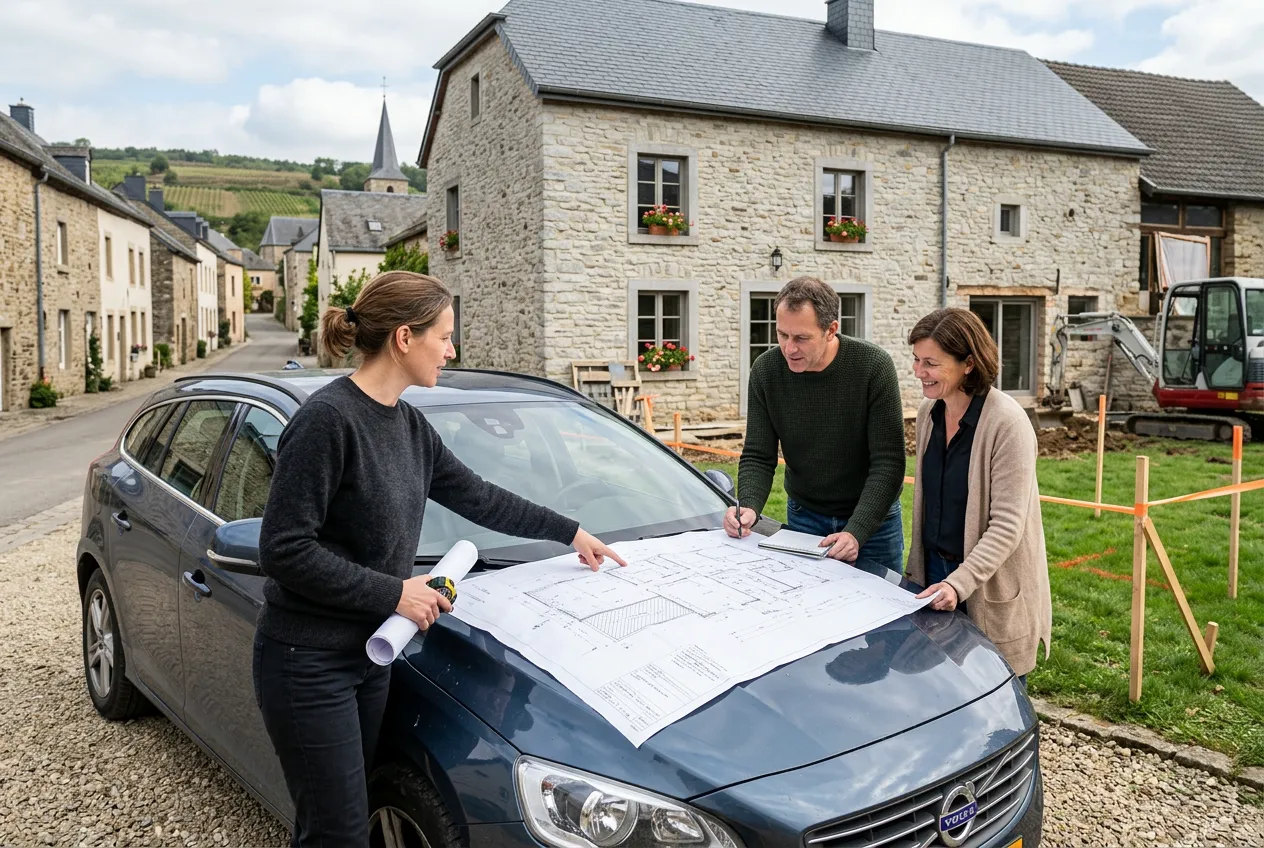
Which works require a building permit?
All those that create, transform, change the use of or demolish a building. That is the principle of Article 37 of the amended law of 19 July 2004 on municipal planning, and the permit is issued by the mayor of your municipality. Add to this earthworks, fences along the public road and advertising devices. Each municipality can then exempt certain minor works in its building regulations, or on the contrary list others explicitly.
| Works | Permit as a rule? | Example observed |
|---|---|---|
| Extension, conservatory, extra storey | Yes, everywhere | Esch-sur-Alzette, conservatory approved in 2025 |
| Facade: insulation, render, colour | Yes in most municipalities | Esch: "any transformation of facades" |
| Roof: renewal, dormer, external insulation | Yes in most municipalities | Esch and Mersch regulations |
| Window replacement | Often, especially on the street side | Esch, several permits in 2025 |
| Solar panels | Often, simplification announced | Esch, dozens of permits in 2025 |
| Outdoor heat pump unit, air conditioning | Often, as fixed technical equipment | Esch, heat pump approved in April 2025 |
| Garden shed, carport, pergola | Yes in many municipalities | Esch, shed approved in April 2025 |
| Interior works not touching structure, facade or roof | Rarely, except new dwelling or change of use | Depends on the regulations |
Trends observed in building regulations and in permit lists published by municipalities. Only your municipality's regulations are authoritative.
Keep one simple rule: if the neighbours can see the difference from the street or their garden, ask the municipality before ordering.
Works declaration or permit: what is the difference?
The law only knows the permit; the declaration is a flexibility some municipalities grant for small works. In practice, several municipalities, such as Mersch, use a single form "building permit application / works declaration". For a shed of a few square metres, an identical window replacement or a low fence at the back of the garden, your municipality may accept a simplified file, or no formality at all. For others, the same job requires full plans.
Three reflexes before starting anything:
- Read the building regulations of your municipality, often called the regulations on buildings, public roads and sites. They are published on the municipality's website.
- Write to the technical department with a photo, a sketch and the dimensions. An answer by e-mail is worth more than a "no problem" on the phone: the courts point out that an oral agreement has no value.
- Have the procedure written into the quote. Who draws up the plans, who files the application, and does the job only start after the permit? A serious contractor asks the question before you do.
What do the PAG and PAP have to do with your project?
They say what you are allowed to build; the permit only checks that you comply with them. The general development plan (PAG) divides the municipality into zones: residential, mixed, green zone, protected districts. The special development plan (PAP), for an "existing district" or a "new district", sets the details: height, depth, setbacks from boundaries, roof shape, sometimes materials and colours. guichet.lu points it out: the permit is granted only if the works comply with the PAG, the PAP and the building regulations.
What this changes for you:
- A conservatory or extension can be refused because it exceeds the authorised building depth, however beautiful it is.
- External facade insulation adds 15 to 25 centimetres. On a street alignment or property boundary, those centimetres count: ask the municipality how it treats them.
- A protected district or building often imposes specific windows, tiles or colours. For a nationally listed building, the Institut national pour le patrimoine architectural is involved as well.
- In the green zone, outside the building perimeter, an authorisation from the Minister for the Environment is needed in addition to the mayor's.
Recent PAGs can be consulted on the national geoportal. Ten minutes of reading avoid a refusal that costs three months.
Solar panels and heat pumps: which specific rules apply?
Today, many municipalities still require a permit for both, but solar is being simplified. The permit list published by Esch-sur-Alzette in May 2025 contains dozens of rooftop panel files, and a heat pump approved together with panels on a single-family house.
Solar panels. In its "Einfach sier erneierbar" package presented in May 2025, the government announced the removal of all municipal formalities for installations up to 30 kW, which covers almost every house roof. This measure goes through the so-called "housing package" bill, filed with the Chamber of Deputies on 21 January 2025. Until your municipality confirms that it applies, assume its current regulations remain valid. On a protected building, criteria set by grand-ducal regulation are to govern installation.
The air-to-water heat pump. The outdoor unit is fixed technical equipment. Several municipal regulations explicitly subject it to a permit and can impose a location away from the street facade or a distance from the neighbouring boundary, notably because of noise. Discuss the location with the installer before choosing the model.
The permit and the grant are two separate files: getting the Klimabonus grant does not exempt you from the municipality, and vice versa.
How does the application work, step by step?
Allow from a few weeks for a small file to several months for an extension, depending on the municipality and the quality of the file:
- Check the rules. PAG, PAP, building regulations, any heritage protection. The technical department often answers a preliminary request.
- Have the plans drawn up. In principle, only an architect may sign them. One is not required for interior works that touch neither the load-bearing structure, nor the facade, nor the roof. For a shed or windows, your contractor often supplies the technical sheets requested.
- File the application with the mayor. The documents required vary from one municipality to another; an incomplete file is the first cause of delay.
- Display the permit on site. The certificate must be displayed visibly and legibly on the site, and the municipality publishes the permit. Third parties have three months from the posting to lodge an appeal with the administrative court.
- Start on time. The permit lapses if the works do not start significantly within the set period, usually one year, with a possible extension on request. Esch-sur-Alzette, for example, grants at most two one-year extensions. Read the deadline stated on your own permit.
- Plan for other permits. Scaffolding or a skip on the pavement requires a road-use permit, and a listed building an authorisation from the Ministry of Culture.
What do you risk if you build without a permit?
A lot, and for a long time. Article 107 of the municipal planning law punishes works without a permit or not complying with it with imprisonment of eight days to two months and a fine of €251 to €125,000, or one of these penalties only. The court can also order the removal of the works and the restoration of the site to its original state, at the offender's expense, or bringing them into line with the approved plans.
The courts do not compromise on detail. In October 2025, the court in Diekirch ruled on a wall built higher than planned: a permit is interpreted strictly, it only covers the plans filed, and the oral agreement claimed with a municipal officer was not accepted for lack of a written trace.
The risk does not stop at the courtroom:
- When selling, the notary and the buyer's bank can ask for the permits. A conservatory without papers lowers the price or scares the buyer away.
- With grants, the building permit serves as a reference point: Klimabonus energy renovation requires a dwelling whose permit is more than ten years old.
- With the neighbours, an unauthorised building is a ready-made argument in a dispute.
Frequently asked questions
Do you need a permit to replace windows in Luxembourg?
Often, especially on the street side or if the colour, shape or divisions change. Esch-sur-Alzette, for example, issued several permits for window replacements in 2025. Ask your municipality in writing before ordering.
Does a garden shed need a building permit?
In many municipalities, yes: building regulations often cover sheds, carports and pergolas "of any kind". Some municipalities accept a simple declaration for small sheds. Only your municipal regulations are authoritative.
Do solar panels need a permit?
Today, many municipalities still require one. In 2025 the government announced the removal of municipal formalities for installations up to 30 kW; check with your municipality whether the measure already applies.
How long does a building permit remain valid?
It lapses if the works do not start significantly within the set period, usually one year, with a possible extension on request. Third parties have three months after the posting on site to lodge an appeal.
What do you risk by building without a permit?
Eight days to two months of imprisonment and a fine of €251 to €125,000, or one of these penalties, under Article 107 of the municipal planning law. The court can also order demolition or compliance work at your expense.
One price means little without a second
One request. Up to 7 quotes from Luxembourg tradespeople. You pay nothing, you sign nothing.
Request my quotesOfficial references
guichet.lu, demander une autorisation de bâtir (construction, transformation, démolition) · Administration de l'environnement, mesures « Einfach sier erneierbar » et autorisations en zone verte · Klima-Agence, conseil en énergie indépendant · guichet.lu, Klimabonus 2026 : rénovation énergétique du logement